No Trailers found.
Filmmaker Herbert Alfonso and musician Glenn de Randamie travel to Ghana to do some research on polyrhythm and the West-African spirituality. However, their trip to The Motherland makes them realize that home is more than the place where they grew up. Years later, they recollect their faded memories and try to find the right words to describe their intense experience. What exactly made them feel at home and lost at the same time? What does being home actually mean for a black individual from Europe while visiting Africa? Only abstractions seem to persevere as this colourful and musically-charged collage serves to show how a life-changing experience can leave us with nothing but fragments of a truth that has yet to be discovered.
At the heart of London, Ontario, lies Xuux Artist Venue—a creative hive buzzing with music, poetry, performance, and collaboration. In The Hive is a documentary that immerses viewers in the world of this community-driven studio, where artists of all disciplines find refuge, inspiration, and belonging.
A documentary film that follows the lives of first-generation retired immigrants living in Finland.
The story of a young boy forced to spend all five years of his short life in hospital while the federal and provincial governments argued over which was responsible for his care, as well as the long struggle of Indigenous activists to force the Canadian government to enforce “Jordan’s Principle” — the promise that no First Nations children would experience inequitable access to government-funded services again.
In a continuation of her first film We Are Not Speaking the Same Language, Danika explains what it feels like to be displaced Indigenous urban.
Since more than 10 years the director Darío Aguirre lives between two totally different worlds, Germany and Ecuador. He decides to make an extraordinary journey, visiting five unknown men called Darío Aguirre as well: One in Mexico and four in Argentina. Meeting each other develops into a reconcilement with their own past lives and permits a brief glance into the protagonists’ present time. For two months Darío shares five different lives, adapting himself to situations and activities he has never done before.
No overview available.
This documentary follows two long-lost Ukrainian friends, Arsalan and Nastya, as they reconnect in Germany after russia's full-scale invasion against Ukraine. Arsalan, an actor now in Frankfurt after time in a refugee camp, and Nastya, journalist and producer who stayed in Kyiv, reflect on the divergent paths their lives have taken due to the war. Through their conversations and therapy sessions, the film explores themes of displacement, identity, and the emotional impact of war on youth.
"Africa Light" - as white local citizens call Namibia. The name suggests romance, the beauty of nature and promises a life without any problems in a country where the difference between rich and poor could hardly be greater. Namibia does not give that impression of it. If you look at its surface it seems like Africa in its most innocent and civilized form. It is a country that is so inviting to dream by its spectacular landscape, stunning scenery and fascinating wildlife. It has a very strong tourism structure and the government gets a lot of money with its magical attraction. But despite its grandiose splendor it is an endless gray zone as well. It oscillates between tradition and modernity, between the cattle in the country and the slums in the city. It shuttles from colonial times, land property reform to minimum wage for everyone. It fluctuates between socialism and cold calculated market economy.
Brayden Olson has spent his life wondering about the father he never knew. Armed with only a name, a faded photograph, and an improbable lead, he sets out across continents to uncover the mystery of Carlos. But as each revelation brings him closer to the truth, Brayden risks unraveling the life he’s always known — especially the bond with the mother who raised him alone. Raw, intimate, and deeply human, Finding Carlos explores identity, family, and the silent epidemic of fatherlessness.
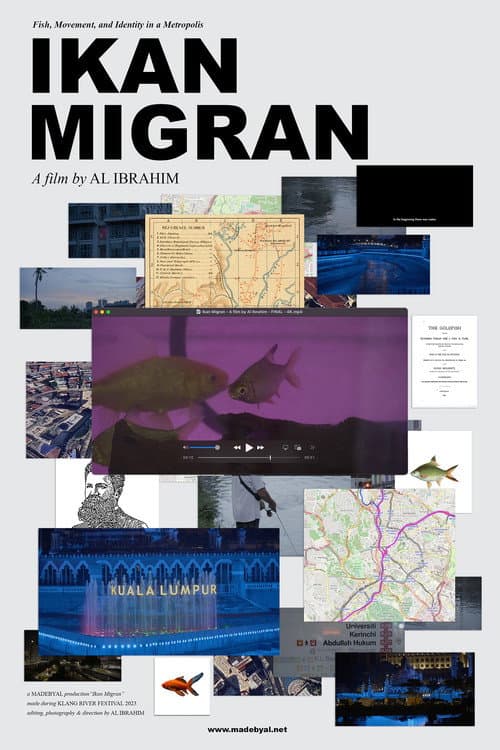
A documentary short that uses fish to explore identity and belonging in a metropolis.
In 2022, when the economic crisis in her native country was at its peak, she decided to visit her family there. She turned her short trip into a collage-like diary in which she reflects on her relationship with her homeland, which is in a state of protracted decay. The film is composed of spontaneous snapshots capturing the author's stay, interspersed with inserted captions serving as personal, often poetically formulated comments and observations. As a result, the film does not hide its strongly subjective perspective, but at the same time builds on it to make an important statement that shows the transformation of Lebanese society in everyday details such as the appearance of the city itself or in the intimate sphere of the author's family life.
Julie Wyman’s quest to find her place within the little people (LP) community at a moment when dwarf identity is poised to radically change. As Julie unpacks the rumors of “partial dwarfism” in her family she finds that hers is the last of a body type she has inherited. She joins forces with a group of dwarf artists to confront the legacy of being tokenized and put on display.
Spontaneous portrait of an endearing and cheerful teenager living in balance between traditionalism and modernity. She presents her regalia to us and we share her pride in being Innu.
The story of three Turkish men. They all grew up in Switzerland and all got deported after various criminal offenses.
The documentary proposes a unique meeting with the speakers of several indigenous and inuit languages of Quebec – all threatened with extinction. The film starts with the discovery of these unsung tongues through listening to the daily life of those who still speak them today. Buttressed by an exploration and creation of archives, the film allows us to better understand the musicality of these languages and reveals the cultural and human importance of these venerable oral traditions by nourishing a collective reflection on the consequences of their disappearance.
Edward Said's book Orientalism has been profoundly influential in a diverse range of disciplines since its publication in 1978. In this engaging and lavishly illustrated interview he talks about the context within which the book was conceived, its main themes, and how its original thesis relates to the contemporary understanding of "the Orient" as represented in the mass media. "That's the power of the discourse of Orientalism. If you're thinking about people and Islam, and about that part of the world, those are the words you constantly have to use. To think past it, to go beyond it, not to use it, is virtually impossible, because there is no knowledge that isn't codified in this way about that part of the world." -Edward Said
Lesley, in her 80s, and teenager Jay deliver spoken word poetry expressing their sense of belonging, home, and their vision for the future of the area where they live. One in a series of short films made in collaboration with residents of Ebbsfleet and its surrounding areas.
Rio Paranaíba
Anair Jovem
Herself
Himself
Milionário
Zé Rico
Neocaipira
Jeca Tatu