logologo
MovieVerse© 2024
Privacy PolicyTerms of ServiceContact Us
Made with ❤️ by Thathsara
movie poster
Afric Hotel
Sign in to create your own watchlist

Afric Hotel

Jan 12, 2011
0h 54m
★ 10.0

Overview

In the furnace of Algiers, the camera follows and accompanies Ibrahim, Adam, and Ismael, originally from sub-Saharan Africa, in an irregular situation who live in this hotel with the predestined name. They live from odd jobs. One is an elevator operator in a building, the second is a shoemaker and the third works in the construction sector. The other side of immigration from sub-Saharan Africa. Behind the statistics hide people, bodies waiting to be able to start another life elsewhere. A hotel thus becomes a transit point in which stories and hopes mingle, a place which seems suspended in time and space. A static journey waiting for another to begin.

Genres

Documentary

Production Companies

Fugues de Barbarie

Afric Hotel Trailers

No Trailers found.

Cast

No Cast found.

You may also like

143 Sahara Street
7.0

143 Sahara Street

Jun 16, 2021

Alone in a small white house on the edge of national road 1, the Trans-Saharan road, which connects Algiers to Tamanrasset crossing the immensity of the desert, Malika, 74, one day opened her door to the director Hassen Ferhani, who came there to scout with his friend Chawki Amari, journalist at El Watan and author of the story Nationale 1 which relates his journey on this north-south axis of more than 2000 km. The Malika of Amari's novel, which Ferhani admits to having first perceived as a "literary fantasy", suddenly takes on an unsuspected human depth in this environment naturally hostile to man. She lends herself to the film project as she welcomes her clients, with an economy of gestures and words, an impression reinforced by the mystery that surrounds her and the rare elements of her biography which suggest that she is not from the region, that she left the fertile north of Algeria to settle in the desert where she lives with a dog and a cat.

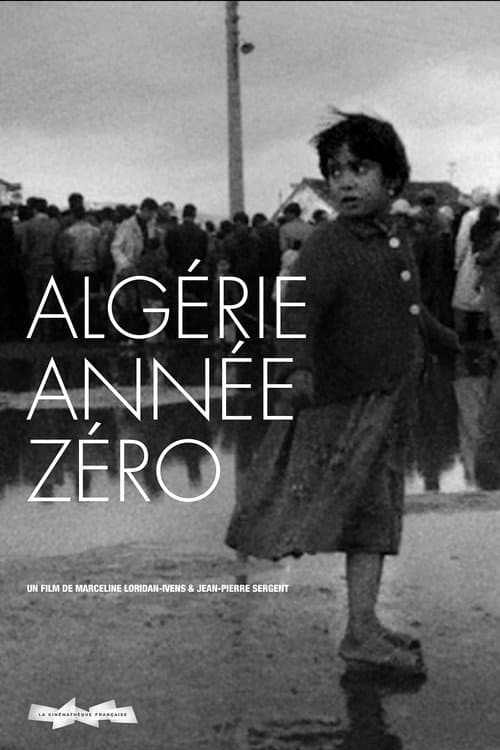
Algeria, Year Zero
10.0

Algeria, Year Zero

Oct 1, 1965

Documentary on the beginnings of Algerian independence filmed during the summer of 1962 in Algiers. The film was banned in France and Algeria but won the Grand Prize at the Leipzig International Film Festival in 1965. Out of friendship, the production company Images de France sent an operator, Bruno Muel, who later declared: "For those who were called to Algeria (for me, 1956-58), participating in a film on independence was a victory over horror, lies and absurdity. It was also the beginning of my commitment to the cinema."

Algérie du possible
7.5

Algérie du possible

Dec 7, 2016

By meeting his former comrades in combat, the film follows the journey of Yves Mathieu, anti-colonialist in Black Africa then lawyer for the FLN. When Algeria became independent, he drafted the Decrees of March on vacant property and self-management, promulgated in 1963 by Ahmed Ben Bella. Yves Mathieu's life is punctuated by his commitments in an Algeria that was then called "The Lighthouse of the Third World". The director, who is his daughter, returns to the conditions of his death in 1966.

Le Choix de mon père
10.0

Le Choix de mon père

Sep 27, 2008

No overview available.

Emilie Busquant, an Algerian passion
10.0

Emilie Busquant, an Algerian passion

Jan 26, 2015

Emilie Busquant, a woman with an exceptional destiny, was born on March 3, 1901, in Neuves-Maisons, Lorraine. In 1923, she moved to Paris to find work and met Messali Hadj, who had also come seeking employment. A beautiful love story began; she fell in love with both a man and a cause: the independence of Algeria. Together, in 1926, they founded the first Algerian independence party, the North African Star (Étoile Nord-Africaine). She would support the Algerian people's struggle throughout her life.

The Unpredictable Factor
0.0

The Unpredictable Factor

Nov 3, 2022

In today's climate debate, there is only one factor that cannot be calculated in climate models - humans. How can we nevertheless understand our role in the climate system and manage the crisis? Climate change is a complex global problem. Increasingly extreme weather events, rising sea levels, and more difficult living conditions - including for us humans - are already the order of the day. Global society has never faced such a complex challenge. For young people in particular, the frightening climate scenarios will be a reality in the future. For the global south, it is already today. To overcome this crisis, different perspectives are needed. "THE UNPREDICTABLE FACTOR" goes back to the origins of the German environmental movement, accompanies today's activists in the Rhineland in their fight against the coal industry and gives a voice to scientists from climate research, ethnology and psychology.

Ma famille entre deux terres
7.0

Ma famille entre deux terres

Jun 1, 2015

No overview available.

Perdus entre deux rives, les Chibanis oubliés
10.0

Perdus entre deux rives, les Chibanis oubliés

Jul 4, 2014

No overview available.

Glimpses of Morocco and Algiers
6.5

Glimpses of Morocco and Algiers

Aug 4, 1951

This FitzPatrick Traveltalk short visits the cities of Casablanca, Rabat, and Marrakesh in Morocco, as well as the city of Algiers in Algeria.

Di Vento e Di Voci
0.0

Di Vento e Di Voci

Sep 18, 2025

No overview available.

The Pan-african Festival in Algiers
6.0

The Pan-african Festival in Algiers

Jan 1, 1969

Festival panafricain d'Alger is a documentary by William Klein of the music and dance festival held 40 years ago in the streets and in venues all across Algiers. Klein follows the preparations, the rehearsals, the concerts… He blends images of interviews made to writers and advocates of the freedom movements with stock images, thus allowing him to touch on such matters as colonialism, neocolonialism, colonial exploitation, the struggles and battles of the revolutionary movements for Independence.

The Revolution Of El Harrachi
10.0

The Revolution Of El Harrachi

Nov 12, 2014

The artistic journey of Dahmane El Harrachi, born in 1925 in Algiers, bears the mark of his experience. An attentive and vigilant observer of the environment of immigrant workers, Dahmane has always avoided falling into the ambient miserabilism. From the Algerian Chaâbi, he has kept certain melodic lines and a clear propensity for sayings drawn from the oral poetic tradition. El Harrachi uses simple language, understandable by all popular sectors of the Maghreb, which partly explains its wide success. In 1949, he went to France and it was in cafes, springboard places where people come to breathe the air of the country, that he performed regularly. Elegant, with his beautiful atmosphere, the “bluesman” of the suburbs seduces, upsets and stirs consciences. Discovered late by the new generation, the creator of Ya Rayah met a tragic end, on August 31, 1980, in a car accident, on the Algiers coast which he sublimated above all else.

The Guest
10.0

The Guest

Nov 14, 2024

In 2021, the border area between Poland and Belarus became a forbidden zone, three kilometers wide, where refugees found themselves brutally trapped. They had become the stakes in a political game: Belarus supposedly guaranteed free passage to the EU, but in Poland the refugees met with pushbacks, forcing them back across the border. Once in Belarus again, they were driven back towards Poland—a horrific stalemate in an inhospitable landscape of treacherous marshes.

Oversand
10.0

Oversand

Jan 1, 1981

Oversand is one of the first films about free climbing, the third film in a series of three with "Overdon" and "Over-Ice". Directed by Jean-Paul Janssen, the film was shot in 35mm in Algeria, in the Sahara Desert, in the Tamanrasset region, on the walls of the majestic peaks of the Atakor massif, central sub-region of Hoggar, mountainous heart of Hoggar, a volcanic plateau of almost circular shape, whose average altitude is 2000 meters, and which culminates at Mount Tahat (2918m), the highest point in Algeria. The Atakor is distinguished by its spectacular volcanic peaks, its needles, and its rugged landscapes, resulting from the erosion of ancient volcanic chimneys, which make it the most emblematic summits of the Hoggar, such as the Assekrem, the Ilamane, or the Tizouyag, where climbers Patrick Edlinger, Patrick Bérhault, Bernard Gorgeon, Hugues Jaillet, Jacques Perrier, Stéphane Troussier and Odette Schoënleb evolve under the watchful eye of the Tuareg caravans.

Des femmes
8.0

Des femmes

May 12, 2020

As the peaceful and determined Hirak movement gathers momentum and hopes for profound political change sweep across Algeria, women are combining femininity and feminism in the past, present, and future.

Qui êtes vous Mr. Iguerbouchène ?
10.0

Qui êtes vous Mr. Iguerbouchène ?

Jan 1, 2014

Mohamed Iguerbouchène was born on February 7, 1907 in Aït-Ouchen in Algeria. He left for England in 1923 where he studied music and harmony. Subsequently, he went to Vienna, Austria, to learn piano techniques where he won 1st prize in harmony and piano. Mohamed Iguerbouchen became a composer, he composed four symphonies and several film scores including the famous “Pépé le Moko” (1937) with Jean Gabin. Mohamed Iguerbouchène bowed out on August 21, 1966 following a long illness.

Mestre Edison Carneiro
0.0

Mestre Edison Carneiro

Jan 1, 2012

Video dedicated to the celebration of the centenary of Edison Carneiro’s birth, one of the great exponents of folklore studies in Brazil, whose contribution remains present to this day, forming important documentary collections and influencing the institution’s mission.

L'Orientalisme
10.0

L'Orientalisme

Aug 27, 2019

Orientalism is a literary and artistic movement born in Western Europe in the 18th century. Through its scale and popularity, throughout the 19th century, it marked the interest and curiosity of artists and writers for the countries of the West (the Maghreb) or the Levant (the Middle East). Orientalism was born from the fascination of the Ottoman Empire and followed its slow disintegration and the progression of European colonizations. This exotic trend is associated with all the artistic movements of the 19th century, academic, romantic, realistic or even impressionist. It is present in architecture, music, painting, literature, poetry... Picturesque aesthetics, confusing styles, civilizations and eras, orientalism has created numerous clichés and clichés that we still find today in literature or cinema.

L'Algérie de Gustave Guillaumet (1840-1887)
10.0

L'Algérie de Gustave Guillaumet (1840-1887)

Oct 17, 2018

Born on March 25, 1840, Gustave Guillaumet discovered Algeria by chance when he was about to embark for Italy. Over the course of his ten or eleven trips and extended stays, he established a familiarity with this space. Traveling through the different regions from north to south, he never ceases to note the differences. He is also the first artist, apart from Delacroix's Women of Algiers, to penetrate into female interiors and reveal the reality, far removed from the harem fantasies that reigned in his time. Fascinated by the country, its deserts and its inhabitants , going so far as to live like the Algerians, Gustave Guillaumet devoted his life and his painting to this country, breaking with the colorful and exotic representations of the time. The painting The Famine in Algeria, restored thanks to exceptional fundraising, was dictated by the events of the years 1865-1868, and well illustrates his knowledge of the country, in a manner that is at once demanding, sensitive and serious.

Les Mains Libres
10.0

Les Mains Libres

Aug 14, 1965

In 1964, Algeria, just two years after the end of the war of independence, found itself catapulted into new contradictions, a still rural territory which responded to the modernity brought by the revolution. Filmed during the winter of 1964-1965 by the young director Ennio Lorenzini, it is the first international Algerian production which paints a rare portrait in color of a multifaceted nation, far from the simplistic vision created by the press and the French army. Produced by Casbah Film, Les Mains Libres (initially titled Tronc De Figuier) bears witness to the stigmata of colonization and the future of free Algeria throughout the Algerian territory and reveals the richness of its landscapes and the diversity of its traditions . The documentary, using the aesthetics of militant cinema of the time, is made up of four scenes: Sea and Desert, The Struggle, The Earth, Freedom.