No Trailers found.
How safe is the future of the world’s food? This documentary explores a growing crisis in world agriculture. Plant breeding has created today’s crops, which are high yielding but vulnerable to disease and insects. To keep crops healthy, breeders tap all the genetic diversity of the world’s food plants. But that rich resource is quickly being wiped out. (NFB)
An apocalyptic sound of roaring machines incessantly intrudes into the habitats of man and nature. Barren landscapes and deserted villages linger in hypnotic restlessness. A self-destructive system meets resistance.
A portrait of a small Ontario town, this film introduces its audience to the people of Holstein by filming them in the old-fashioned general store, the blacksmith's shop and the town granary. Old-time residents reminisce, while old-fashioned sleighs travel down the main road bordered by beautiful old frame houses.
1 village, 1.000 tractors, 100.000 tons of cabbages & potatoes each year - which are hardly sold and eventually destroyed. Is there any way out?
A festival of digestion on many scales, from planetary to microbial.
Care work, awareness-raising, waste reduction. Thieboudienne, chaufa, paella. What do these recipes have in common? Who cooks them? Where?
Brazil is one of the most dangerous countries for environmentalists. The rural community of Belisário holds the country's second largest bauxite reserve, right below one of the most bio-diverse areas in the world: the Atlantic Forest. The small community was shaken when the beloved Gilberto, a Franciscan Friar, received a death threat followed by the lines: "you've been talking against mining way too much". PT: O Brasil é um dos países mais perigosos do mundo para defensores do meio ambiente. Em Minas Gerais, a comunidade rural de Belisário abriga a segunda maior reserva de bauxita do país, em uma das áreas de maior biodiversidade do mundo: a Mata Atlântica. A tranquilidade do pequeno vilarejo foi abalada quando Frei Gilberto, um franciscano que dedica sua vida à preservação da natureza, recebeu uma ameaça de morte com o seguinte aviso: "você tem falado demais contra a mineração".
This explores the reality of chefs and cooks as they struggle to create dishes and experiences enjoyed on a daily basis. The restaurant industry is a tough business, not just for profits, but for everyone involved.
Merging sweeping wine country footage with insightful interviews, filmmaker Lori Miller showcases the dynamic natural wine movement that is transforming a growing number of Northern California vineyards.
The drought in the American West is predicted to be the worst in 1,000 years. Join five Academy Award-winning filmmakers as they explore the environmental crisis of our time and how to fix it before it's too late.
As the global economics of dairy farming has winnowed out most small and medium-sized dairies, the surviving farmers confront pressures to intensify production, even as they find that getting bigger presents new problems.
Two countries, two restaurants, one vision. At Gabriela Cámara's acclaimed Contramar in Mexico City, the welcoming, uniformed waiters are as beloved by diners as the menu featuring fresh, local seafood caught within 24 hours. The entire staff sees themselves as part of an extended family. Meanwhile at Cala in San Francisco, Cámara hires staff from different backgrounds and cultures, including ex-felons and ex-addicts, who view the work as an important opportunity to grow as individuals. A Tale of Two Kitchens explores the ways in which a restaurant can serve as a place of both dignity and community.
In Turkey far too many women are still unable to read and write, and all they see in their life span is being forced into early marriage and relegation to the home, where they look after extended families and more children than they can feed. The girls are portrayed in their homes, together with the strongest supporters of their emancipation through education: their mothers. Girls of Hope portrays five girls who struggle for their education and, despite all the difficulties, try to hold on to their hope for a better future.
The last ten years have seen a phenomenal explosion in the organic food movement as it has moved from niche market to mainstream. Today, it is the fastest growing segment of the food industry attracting all of the major food corporations. THE NEW GREEN GIANTS looks at a number of these new and old organic corporations and shows how they are managing, or in some cases, failing to live up to the idealistic dreams first espoused by the back-to-the land folk of the late sixties and early seventies. The documentary also looks at some of the bigger questions surrounding organic food. Is it really healthier? Is it truly organic? Is it possible to grow from a mom-and-pop operation to become a huge supplier of major grocery chains? Is it actually sustainable? Is it realistic to think the world can be fed organically?
No overview available.
They are frozen in place, stagnating without any direction. Around them, things change rapidly.
Ketchup and mayonnaise have experienced a global success. We love them, but we know almost nothing about them. How have they crossed the centuries and continents since their creation? From industrial tomatoes, specially shaped for the industrial process, to dried egg yolk powder dedicated to the food industry, industrial version sauces are surprising. However, it is possible today to eat gourmet versions of ketchups and mayonnaise. And it is not of little consequence to choose quality ones, because scientifically, they are indeed addictive.
King Corn is a fun and crusading journey into the digestive tract of our fast food nation where one ultra-industrial, pesticide-laden, heavily-subsidized commodity dominates the food pyramid from top to bottom – corn. Fueled by curiosity and a dash of naiveté, two college buddies return to their ancestral home of Greene, Iowa to figure out how a modest kernel conquered America. With the help of some real farmers, oodles of fertilizer and government aide, and some genetically modified seeds, the friends manage to grow one acre of corn. Along the way, they unlock the hilarious absurdities and scary but hidden truths about America’s modern food system in this engrossing and eye-opening documentary.
Beginning with a private, rolling party on board one of Hong Kong's iconic streetcars, travel journalist Rudy Maxa and former chef and now Washington, D.C. restaurateur Daisuke Utagawa lead viewers through on of the worlds most exciting cities. Hong Kong takes cuisine from around the world and makes it its own. Explore the cuisine as well as the mostly unknown, lush side of Hong Kong where hiking trails and beaches rule. Bangkok - In a city where the weather is always hot, it is natural that residents spend so much time eating outside. Street food rules the capital of Thailand, and no visitor should miss the opportunity to follow local custom. Utagawa and Maxa taste their way through the city while exploring the Klongs (canals) and temples that make Bangkok a visitors paradise.
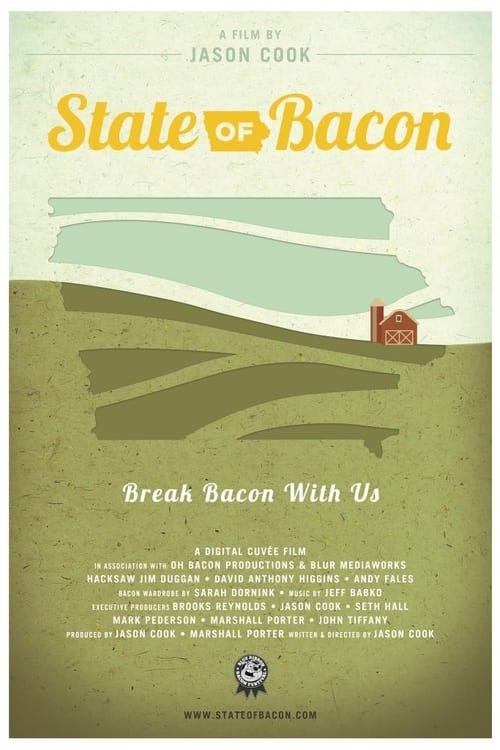
State of Bacon tells the kinda real but mostly fake tale of an oddball group of characters leading up to the annual Blue Ribbon Bacon Festival. Bacon-enthusiasts, Governor Branstad, a bacon queen, Hacksaw Jim Duggan, members of PETA, and an envoy of Icelanders are not excluded from this bacon party and during the course of the film become intertwined with the organizers of the festival to show that bacon diplomacy is not dead.
No Cast found.