logologo
MovieVerse© 2024
Privacy PolicyTerms of ServiceContact Us
Made with ❤️ by Thathsara
movie poster
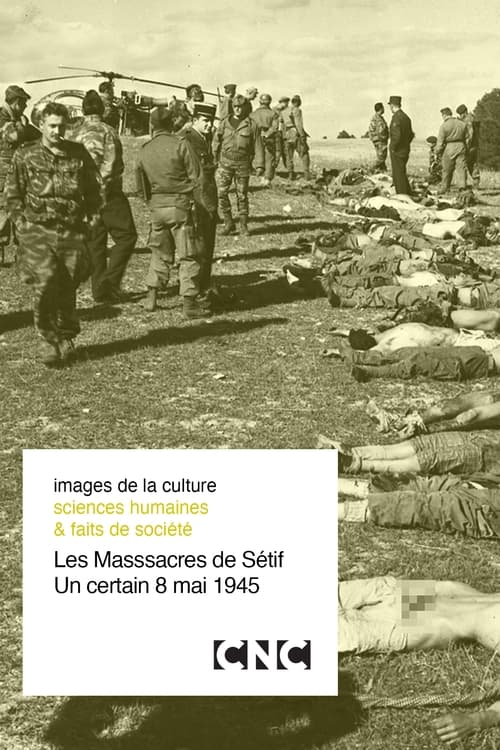
The Setif Massacres, a certain May 8, 1945
Sign in to create your own watchlist

The Setif Massacres, a certain May 8, 1945

May 10, 1995
0h 56m
★ 10.0

Overview

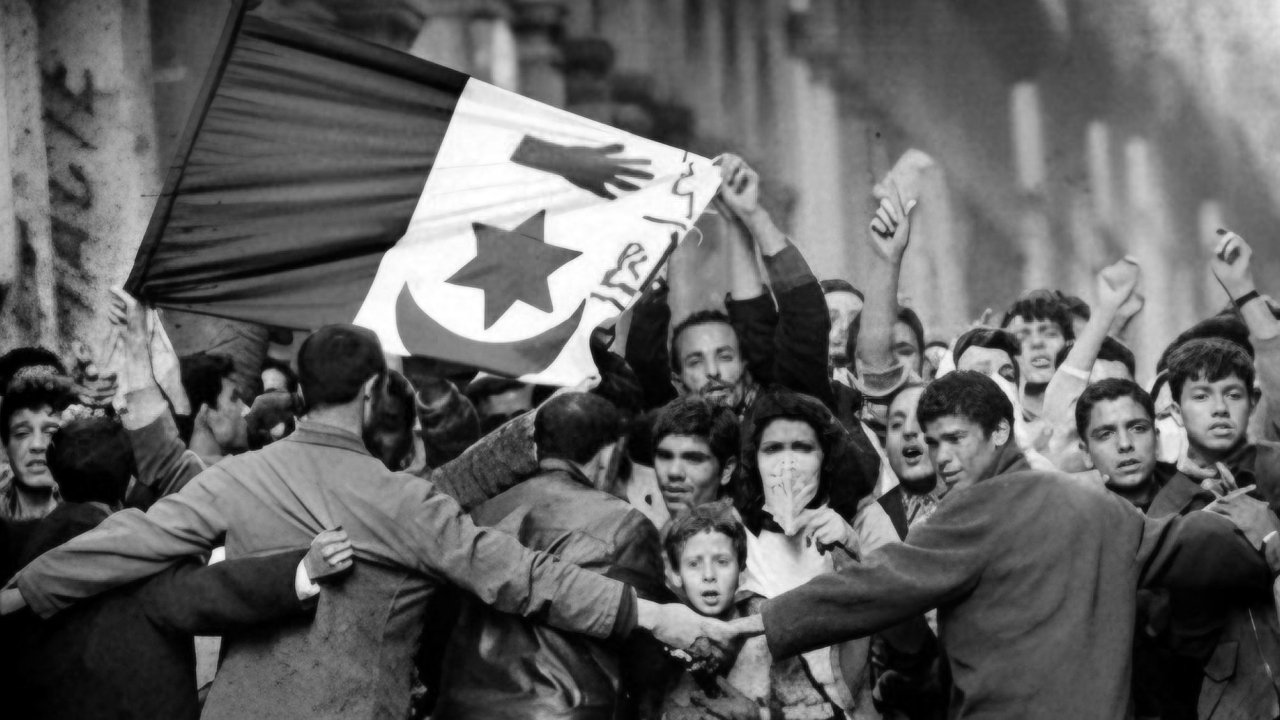
May 8, 1945, the day of victory over Nazism, is also a day of mourning. In Algiers, thanks to demonstrations for victory, the Algerian flag appears for the first time, thus claiming independence. But in Sétif, the standard bearer is shot dead at the head of the procession and a riot breaks out. The colonial massacre that followed would extend to all of Constantine. The commission of inquiry never delivered its conclusions and an amnesty law erased the traces of this savage repression. Fifty years later, the file is open.

Genres

Documentary
History
War

Production Companies

Mémoires Vives productions
ARTE
Point du Jour
Éditions Au Nom De La Mémoire

The Setif Massacres, a certain May 8, 1945 Trailers

No Trailers found.

Cast

Bernard Langlois

Narrator

Bernard Langlois

You may also like

The Emperor's Naked Army Marches On
7.5

The Emperor's Naked Army Marches On

Aug 1, 1987

Kenzo Okuzaki, a 62-year-old veteran of the New Guinea campaign in World War II, sets out to conduct interviews with survivors and relatives to find the truth behind atrocities committed by Japanese military, in particular the unexplained killing of two Japanese privates in his unit.

Our Algeria
10.0

Our Algeria

Jan 1, 1959

"Djazaïrouna", produced by the cinema service of the Provisional Government of the Algerian Republic (GPRA), is a montage film intended to inform the international community at the UN in 1959 on the objectives pursued by the Algerian resistance during the war of 'Algeria. Independence in Algeria (1954-1962). In 1959, Djamel-Eddine Chanderli and Mohammed Lakdar-Hamina produced Djazaïrouna (Our Algeria) from images taken by René Vautier and Doctor Pierre Chaulet. This film, completed a little later and will result in the film “The Voice of the People”. This documentary on the history of Algeria through a montage of current events, traces the political and military actions of the A.L.N, the demonstrations of December 1960, and the attack on a fortified French base on the border between Algeria and Tunisia.

I Want to Be a Shellfish
8.3

I Want to Be a Shellfish

Sep 22, 2008

1944, in the depths of World War II. Toyomatsu Shimizu is a completely typical barber from a remote sea-side town who lives frugally but happily with his wife Fusae and their five-year-old son. Eventually, though, the army beckons and he is drafted. One day an officer on the battle-field orders him to kill a captive U.S. soldier. Although Toyomatsu lacks the spirit to kill the man, and only wounds him in the arm, the victorious U.S. soldiers will not accept this, and Toyomatsu is arrested and tried as a war-criminal. And he receives the cruelest sentence possible...

Broken Rainbow
5.7

Broken Rainbow

May 5, 1985

Documentary chronicling the government relocation of 10,000 Navajo Indians in Arizona.

Carte Blanche
9.0

Carte Blanche

Aug 10, 2011

A documentary about investigators of the International Criminal Court trying to gather evidence of crimes committed in Africa.

My Enemy's Enemy
7.1

My Enemy's Enemy

Aug 31, 2007

Reveals an alternate history of the post-war world. This is a version of history where, in contrast to what we are all told, fascist ideology prevailed. The story of Klaus Barbie, Nazi torturer, American spy, tool of repressive right-wing regimes, is symbolic of the real relationship that the "Western" governments had with fascism and makes us see the world as it is today - and the politicians that inhabit it - in a different way.

Dead the Long Night
10.0

Dead the Long Night

Jan 2, 1979

Composed of archive images narrated by the writer, anthropologist and linguist Mouloud Mammeri, the film offers a reflection on the anti-colonialist and anti-imperialist struggle movements of the 1970s around the world.

The Uprooted
10.0

The Uprooted

Mar 1, 1977

In 1880, in colonized Algeria, it was decided that the Algerian peasants of the Ouarsenis mountains would see their lands dispossessed in favor of the French colonists. Two methods were used to achieve this, either by sheer force or by a ploy forcing the fellahs to pay fines too high to be paid. The uprooted must then leave for the cities, swelling the mass of proletarians in the slums ...

Opium and the Stick
7.6

Opium and the Stick

Sep 14, 1970

In 1950, in Algeria, in a village in Kabylia, Algerian resistance fighters resisted the French occupation army. Bachir returns to the village to escape the clashes ravaging Algiers. In Thala, he has two brothers, Ali and Belaïd. The first is engaged with the ALN (The National Liberation Army) and fights against the colonizer. His second brother, Belaïd, the eldest, is convinced of a French Algeria. His family torn apart, Bachir decides to join the war and takes sides against the repression of the French army. The French army is trying in vain to turn the population against the insurgents by using disinformation. The more time passes, the more the inhabitants of the village and surrounding areas, oppressed, rally to the cause of the FLN, their houses and their fields will be burned... Adaptation to the cinema of the eponymous novel Opium and the Stick, published in 1965, by Mouloud Mammeri, the film was dubbed into Tamazight (Berber), a first for Algerian cinema.

The Honour of the Tribe
10.0

The Honour of the Tribe

Jan 2, 1993

Like every year in Zitouna, a bear handler passes by. With his creature, he comes to challenge the small community. And like every year, it is Slimane El Mabrouk who defends the honor of the tribe. But this time, he dies, leaving two orphans, Omar and Ourida. Robbed of their inheritance, the children will grow up alone. The years pass, the French army settles in, and with it, the war. Mysteriously, one day, after the murder of a French legionnaire, Omar disappears into the bush, while his sister dies in childbirth. Omar will return to the village, much later, once independence has been acquired, as a representative of power and with this enigmatic formula: "You must know that the Revolution has not forgotten you". Personal revenge? Sincere desire to bring progress and modernity? ... The inhabitants of Zitouna, upset in their ancestral way of life, will not be long in having an answer to their questions.

The Inheritance
10.0

The Inheritance

Jan 1, 1975

A harrowing picture of the heritage of colonialism, focusing on a man driven mad by torture but saved by his wife, who restores his sanity and leads the progressive forces to rebuild the village.

Kherson: Human Safari
0.0

Kherson: Human Safari

Aug 14, 2025

Kherson, Ukraine's embattled city, has endured invasion, occupation, and liberation. On February 24, 2022, Russian tanks entered Kherson, leading to brutal occupation marked by violence. Despite being outnumbered, local defense forces resisted, and citizens protested under the slogan "Kherson is Ukraine!" An underground resistance formed, led by brave individuals like journalist Valentyna and others who risked arrest and torture to support the cause. After nine months, Ukrainian forces liberated Kherson, but Russian destruction left the city in chaos. Shelling and drone attacks became relentless, and in June 2023, a dam explosion flooded the city, causing further devastation. Despite these challenges, Kherson's spirit remained unbroken, with citizens embracing arts and resilience. By August 2024, drone attacks specifically targeted civilians, yet the city resisted, determined to rebuild and reclaim its identity, refusing to succumb to ruin.

Sinking of the Lusitania: Terror at Sea
6.7

Sinking of the Lusitania: Terror at Sea

May 12, 2007

The story of the sinking of the Lusitania in 1915 after she was torpedoed off the Irish coast. The story is told from the perspective of Prof. Holbourn (a passenger), the German U-boat and its captain and crew, and other passengers, crew and Admiralty staff

Let Them All Go
0.0

Let Them All Go

Jan 1, 2019

February 22, 2019 marks the start of a historic movement in Algeria, initially against the candidacy of President Bouteflika for a fifth term, then for the departure of all former dignitaries of the regime and the establishment of a Second Republic. Algerian-Canadian filmmaker Sara Nacer returns to Algeria to capture this “Hirak” (movement in Arabic) through her camera. Through her journey, she invites us to discover the young generation who are leading the "Smile Revolution" and building Algeria 2.0, with a strong political, cultural and social awareness.

Under the Wire
8.1

Under the Wire

Sep 7, 2018

On 12 February 2012, two journalists entered war-ravaged Syria. One of them was celebrated Sunday Times war correspondent, Marie Colvin. The other was photographer, Paul Conroy. Their aim was to cover the plight of Syrian civilians trapped in Homs, a city under siege and relentless military attack from the Syrian army. Only one of them returned.

Isabelle Eberhardt
4.5

Isabelle Eberhardt

Nov 21, 1991

The true story of explorer, journalist and writer Isabelle Eberhardt, originally from Switzerland. She moved to Annaba in Algeria in 1897 with her mother, who preferred to live in the Algerian neighborhoods rather than the European neighborhoods that she hated, and converted to Islam. Her lifestyle shocked the French colonialists: she dressed like a man, frequented cafes and smoke shops. Fascinated by the desert, she traveled the Sahara under the identity of Si Mahmoud, she published articles and books on the world she discovered in southern Algeria, strongly criticizing the colonial authorities. Arriving in El Oued, the soldiers prevent him from continuing his journey. She disobeys and overhears officers shooting Arab prisoners. Arrested, she was accused of espionage and was expelled from Algeria. She married Slimane, a Muslim non-commissioned officer in 1901. Having become French through this marriage, she could now reside in Algeria.

Hassan Terro
8.6

Hassan Terro

Jan 2, 1967

While he tries by all means to stay out of the bloody upheavals caused by the battle of Algiers, Hassan, an honest and naive father, unknowingly offers hospitality to a mujahid actively sought by the army. French. A series of events and misunderstandings quickly catapult him to the forefront, presenting him under the pseudonym “Hassan Terro”, a great fictitious terrorist who would have sworn the doom of the French army...

No Image Available
3.1

Angel of Mercy

Feb 11, 1993

The love story between a young widow and an austrian-hungarian army officer during the First World War.

Chronicle of the Years of Fire
6.4

Chronicle of the Years of Fire

Nov 26, 1975

A meticulous chronicle of the evolution of the Algerian national movement from 1939 until the outbreak of the revolution on November 1, 1954, the film unequivocally demonstrates that the "Algerian War" is not an accident of history, but a slow process of suffering and warlike revolts, uninterrupted, from the start of colonization in 1830, until this "Red All Saints' Day" of November 1, 1954. At its center, Ahmed gradually awakens to political awareness against colonization, under the gaze of his son, a symbol of the new Algeria, and that of Miloud, half-mad haranguer, half-prophet, incarnation of Popular memory of the revolt, the liberation of Algeria and its people.

Caterpillar
6.3

Caterpillar

Aug 14, 2010

The story of a village woman given the grueling task of looking after (and fulfilling the sexual needs of) her quadruple amputee husband, a Japanese soldier in the Second Sino-Japanese War who has been decreed a "War God" by the Emperor.