logologo
MovieVerse© 2024
Privacy PolicyTerms of ServiceContact Us
Made with ❤️ by Thathsara
movie poster
1983, The Marchers for Equality
Sign in to create your own watchlist

1983, The Marchers for Equality

Dec 3, 2023
0h 54m
★ 9.5

Overview

In the 1980s, young people of North African descent born in France and a priest from the Lyon suburbs organized the "March of the Beurs." Launched on October 15, 1983, by seventeen people from the La Cayolle neighborhood in Marseille following a racist crime, the march concluded two months later—on December 3—on the streets of Paris, with 100,000 participants. This movement demanded equal rights. Was their cry heard?

Genres

Documentary
TV Movie

Production Companies

Flair Productions
France Télévisions
Citizen Films

1983, The Marchers for Equality Trailers

No Trailers found.

Cast

No Cast found.

You may also like

La Ballade des sans-papiers
8.0

La Ballade des sans-papiers

Jun 12, 1997

No overview available.

False Integration: The Myth of Equality
10.0

False Integration: The Myth of Equality

Jul 9, 2025

Francesco Croquete Margharette leads a journey through the thoughts of Florestan Fernandes and his work The Integration of Black People in Class Society.

143 Sahara Street
7.0

143 Sahara Street

Jun 16, 2021

Alone in a small white house on the edge of national road 1, the Trans-Saharan road, which connects Algiers to Tamanrasset crossing the immensity of the desert, Malika, 74, one day opened her door to the director Hassen Ferhani, who came there to scout with his friend Chawki Amari, journalist at El Watan and author of the story Nationale 1 which relates his journey on this north-south axis of more than 2000 km. The Malika of Amari's novel, which Ferhani admits to having first perceived as a "literary fantasy", suddenly takes on an unsuspected human depth in this environment naturally hostile to man. She lends herself to the film project as she welcomes her clients, with an economy of gestures and words, an impression reinforced by the mystery that surrounds her and the rare elements of her biography which suggest that she is not from the region, that she left the fertile north of Algeria to settle in the desert where she lives with a dog and a cat.

Algeria, Year Zero
10.0

Algeria, Year Zero

Oct 1, 1965

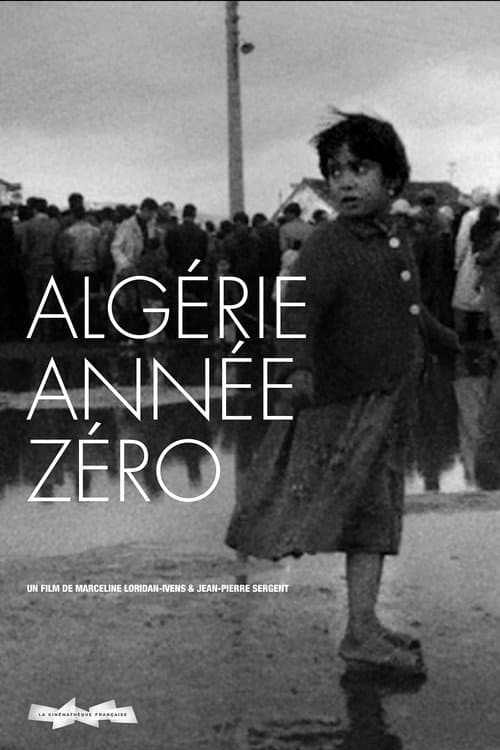
Documentary on the beginnings of Algerian independence filmed during the summer of 1962 in Algiers. The film was banned in France and Algeria but won the Grand Prize at the Leipzig International Film Festival in 1965. Out of friendship, the production company Images de France sent an operator, Bruno Muel, who later declared: "For those who were called to Algeria (for me, 1956-58), participating in a film on independence was a victory over horror, lies and absurdity. It was also the beginning of my commitment to the cinema."

7 A.M. A Documentary
0.0

7 A.M. A Documentary

Jan 17, 2015

Black people face a lot of problems, but the root cause of those issues is our lack of businesses. 7 A.M. is the first documentary ever that talks to leading scholars, academics, and businessmen exploring in depth why racism isn’t a social issue but an economic one. Since the 1960’s we’ve focused on education and politics, however, the solution isn’t building more schools or government positions… The solution is building more businesses.

Nazi Hate Rock
0.0

Nazi Hate Rock

Nov 9, 2006

Donal MacIntyre investigates the secretive world of white power music and how the money made helps fund far right political organizations in many countries, including the British National Party in the UK. In this documentary, the crew gained access to the men and women behind one of the most disturbing musical movements. It reveals how British neo-Nazis and skinheads plan to launch 'Project School-Yard' in Britain after a similar scheme was tried out in the United States. In the UK, the team follows one of the most infamous British white-power bands, Whitelaw, as they prepare for one of the biggest gigs of their career. The band are filmed on stage, with riot police surrounding the venue, performing as the forces of law and order move in to shut down their hate-filled act. The film also contains shocking images of hate rock concerts in the USA where, thanks to the first amendment protecting freedom of speech, anything goes.

Beard, Hair & Stache
0.0

Beard, Hair & Stache

Sep 14, 2016

Afonsinho, Paulo Cézar Caju and Nei Conceição started their careers in the mid-1960s, a time of strong political repression in Brazil. Originally teammates of a celebrated generation of the Botafogo football team superstars, they did not give up their freedom when the military dictatorship decided to take control of the field.

Emilie Busquant, an Algerian passion
10.0

Emilie Busquant, an Algerian passion

Jan 26, 2015

Emilie Busquant, a woman with an exceptional destiny, was born on March 3, 1901, in Neuves-Maisons, Lorraine. In 1923, she moved to Paris to find work and met Messali Hadj, who had also come seeking employment. A beautiful love story began; she fell in love with both a man and a cause: the independence of Algeria. Together, in 1926, they founded the first Algerian independence party, the North African Star (Étoile Nord-Africaine). She would support the Algerian people's struggle throughout her life.

The Unpredictable Factor
0.0

The Unpredictable Factor

Nov 3, 2022

In today's climate debate, there is only one factor that cannot be calculated in climate models - humans. How can we nevertheless understand our role in the climate system and manage the crisis? Climate change is a complex global problem. Increasingly extreme weather events, rising sea levels, and more difficult living conditions - including for us humans - are already the order of the day. Global society has never faced such a complex challenge. For young people in particular, the frightening climate scenarios will be a reality in the future. For the global south, it is already today. To overcome this crisis, different perspectives are needed. "THE UNPREDICTABLE FACTOR" goes back to the origins of the German environmental movement, accompanies today's activists in the Rhineland in their fight against the coal industry and gives a voice to scientists from climate research, ethnology and psychology.

Ma famille entre deux terres
7.0

Ma famille entre deux terres

Jun 1, 2015

No overview available.

Perdus entre deux rives, les Chibanis oubliés
10.0

Perdus entre deux rives, les Chibanis oubliés

Jul 4, 2014

No overview available.

Pour de vrai
0.0

Pour de vrai

Jan 1, 2003

No overview available.

Un racisme à peine voilé
5.2

Un racisme à peine voilé

Jan 1, 2004

October 2003, Alma and Lila Levy are excluded from the Lycée Henri Wallon in Aubervilliers solely because they were wearing a headscarf. What follows is a deafening political and media debate, justifying in most cases the exclusion of girls wearing head-scarves to school. February 2004, a law was eventually passed by the National Assembly. "A thinly veiled racism" is about this controversy since the affair of Creil in 1989 (where two schoolgirls were excluded for the same reasons) and attempts to "reveal" that maybe what hides behind is the desire to exclude these girls. This film gives them a voice as well as others - teachers, community activists, feminists, researchers - gathered around the group "A School for You-All" fighting for the repeal of this law they consider sexist and racist ... This movie was censured in Septembre 2004 in France.

Killing the Indian in the Child
6.5

Killing the Indian in the Child

Feb 18, 2021

The Indian Act, passed in Canada in 1876, made members of Aboriginal peoples second-class citizens, separated from the white population: nomadic for centuries, they were moved to reservations to control their behavior and resources; and thousands of their youngest members were separated from their families to be Christianized: a cultural genocide that still resonates in Canadian society today.

Who We Are: A Chronicle of Racism in America
8.0

Who We Are: A Chronicle of Racism in America

Jan 14, 2022

Jeffery Robinson's talk on the history of U.S. anti-Black racism, with archival footage and interviews.

The Revolution Of El Harrachi
10.0

The Revolution Of El Harrachi

Nov 12, 2014

The artistic journey of Dahmane El Harrachi, born in 1925 in Algiers, bears the mark of his experience. An attentive and vigilant observer of the environment of immigrant workers, Dahmane has always avoided falling into the ambient miserabilism. From the Algerian Chaâbi, he has kept certain melodic lines and a clear propensity for sayings drawn from the oral poetic tradition. El Harrachi uses simple language, understandable by all popular sectors of the Maghreb, which partly explains its wide success. In 1949, he went to France and it was in cafes, springboard places where people come to breathe the air of the country, that he performed regularly. Elegant, with his beautiful atmosphere, the “bluesman” of the suburbs seduces, upsets and stirs consciences. Discovered late by the new generation, the creator of Ya Rayah met a tragic end, on August 31, 1980, in a car accident, on the Algiers coast which he sublimated above all else.

There's Something in the Water
7.3

There's Something in the Water

Sep 6, 2019

Elliot Page brings attention to the injustices and injuries caused by environmental racism in his home province, in this urgent documentary on Indigenous and African Nova Scotian women fighting to protect their communities, their land, and their futures.

Oversand
10.0

Oversand

Jan 1, 1981

Oversand is one of the first films about free climbing, the third film in a series of three with "Overdon" and "Over-Ice". Directed by Jean-Paul Janssen, the film was shot in 35mm in Algeria, in the Sahara Desert, in the Tamanrasset region, on the walls of the majestic peaks of the Atakor massif, central sub-region of Hoggar, mountainous heart of Hoggar, a volcanic plateau of almost circular shape, whose average altitude is 2000 meters, and which culminates at Mount Tahat (2918m), the highest point in Algeria. The Atakor is distinguished by its spectacular volcanic peaks, its needles, and its rugged landscapes, resulting from the erosion of ancient volcanic chimneys, which make it the most emblematic summits of the Hoggar, such as the Assekrem, the Ilamane, or the Tizouyag, where climbers Patrick Edlinger, Patrick Bérhault, Bernard Gorgeon, Hugues Jaillet, Jacques Perrier, Stéphane Troussier and Odette Schoënleb evolve under the watchful eye of the Tuareg caravans.

Barbed Wire and Mandolins
7.0

Barbed Wire and Mandolins

Mar 4, 1997

Upon Canada's entry into World War II, the RCMP rounded up thousands of people it considered fascist sympathizers. Among them, 700 Italian-Canadians were held for up to three years in internment camps. None were ever charged with a criminal offence.

The Ugly Face of Disability Hate Crime
0.0

The Ugly Face of Disability Hate Crime

Jul 23, 2015

Adam Pearson - who has neurofibromatosis type 1 - is on a mission to explore disability hate crime: to find out why it goes under-reported, under-recorded and under people's radar.