logologo
MovieVerse© 2024
Privacy PolicyTerms of ServiceContact Us
Made with ❤️ by Thathsara
movie poster
Surgeon during the Algerian War
Sign in to create your own watchlist

Surgeon during the Algerian War

Jan 9, 2012
1h 10m
★ 0.0

Overview

Has everything really been said about the Algerian war? Although the archives are opening up, almost fifty years after the signing of the Evian Agreements (March 18, 1962), direct witnesses are beginning to disappear. They are, however, unique bearers of history, often the only ones able to illustrate the harsh reality of a long-hidden period. Gérard Zwang, surgeon of the contingent between May 1956 and June 1958, is one of these essential witnesses who help us discover an original history of the Algerian War. During his service, in charge of treating the most atrocious wounds of his fellow soldiers, he sees the war from the side of its victims. He did not fight with a machine pistol in his hand, but behind the closed doors of an operating room where life gives way to death in a matter of seconds.

Genres

Documentary
History
War

Production Companies

CC&C
Planète+

Surgeon during the Algerian War Trailers

No Trailers found.

You may also like

Emilie Busquant, an Algerian passion
10.0

Emilie Busquant, an Algerian passion

Jan 26, 2015

Emilie Busquant, a woman with an exceptional destiny, was born on March 3, 1901, in Neuves-Maisons, Lorraine. In 1923, she moved to Paris to find work and met Messali Hadj, who had also come seeking employment. A beautiful love story began; she fell in love with both a man and a cause: the independence of Algeria. Together, in 1926, they founded the first Algerian independence party, the North African Star (Étoile Nord-Africaine). She would support the Algerian people's struggle throughout her life.

Le Choix de mon père
10.0

Le Choix de mon père

Sep 27, 2008

No overview available.

Algérie du possible
7.5

Algérie du possible

Dec 7, 2016

By meeting his former comrades in combat, the film follows the journey of Yves Mathieu, anti-colonialist in Black Africa then lawyer for the FLN. When Algeria became independent, he drafted the Decrees of March on vacant property and self-management, promulgated in 1963 by Ahmed Ben Bella. Yves Mathieu's life is punctuated by his commitments in an Algeria that was then called "The Lighthouse of the Third World". The director, who is his daughter, returns to the conditions of his death in 1966.

Quando a noite ainda não existia
0.0

Quando a noite ainda não existia

Jul 14, 2023

During the COVID-19 pandemic, a trans body dreams of the birth of night.

Krim Belkacem
10.0

Krim Belkacem

Nov 1, 2014

This film retraces the combat journey of Krim Belkacem, one of the leading figures of the Algerian War. When he left the Dellys barracks in October 1945, the day after the Second World War, Krim Belkacem was 23 years old. He is a man revolted by the May massacres in Sétif, Guelma, Kherrata and several other localities in the ravaged country. But it is also and above all a young Algerian who questions the future of Algeria. On March 21, 1947, Krim at the age of 25, he dug up his "Sten" submachine gun, he took action against the boss of his douar who was none other than his cousin. He goes into hiding with six companions. He meshes this entire part of Algeria with a dense and dense network with the sole objective of taking action which will lead to the outbreak of the armed struggle on November 1, 1954.

The Ugly Face of Disability Hate Crime
0.0

The Ugly Face of Disability Hate Crime

Jul 23, 2015

Adam Pearson - who has neurofibromatosis type 1 - is on a mission to explore disability hate crime: to find out why it goes under-reported, under-recorded and under people's radar.

Fanon
6.6

Fanon

Apr 2, 2025

Frantz Fanon, a French psychiatrist from Martinique, has just been appointed head of department at the psychiatric hospital in Blida, Algeria. His methods contrast with those of the other doctors in a context of colonization. A biopic in the heart of the Algerian war where a fight is waged in the name of Humanity.

Intimate Enemies
6.4

Intimate Enemies

Oct 3, 2007

A drama following a French platoon during Algeria's war of independence.

Le Serment
10.0

Le Serment

Jan 1, 1963

The Oath, a TV film produced by Algerian television in 1963 following the end of the war of independence, tells the story of young Algerians who joined the resistance after the bloody repressions of May 1945 in Constantinois by the French colonial army .

A Captain's Honor
6.1

A Captain's Honor

Dec 29, 1982

During a televised debate on the Algerian war in the early 1980s, Professor Paulet denounced the methods of Captain Caron, killed in action in 1957. The widow of the captain, Patricia, decided to file a defamation suit.

Days of Glory
6.7

Days of Glory

Sep 27, 2006

1943. They have never stepped foot on French soil but because France was at war, Said, Abdelkader, Messaoud and Yassir enlist in the French Army, along with 130,000 other “indigenous” soldiers, to liberate the “fatherland” from the Nazi enemy. Heroes that history has forgotten…

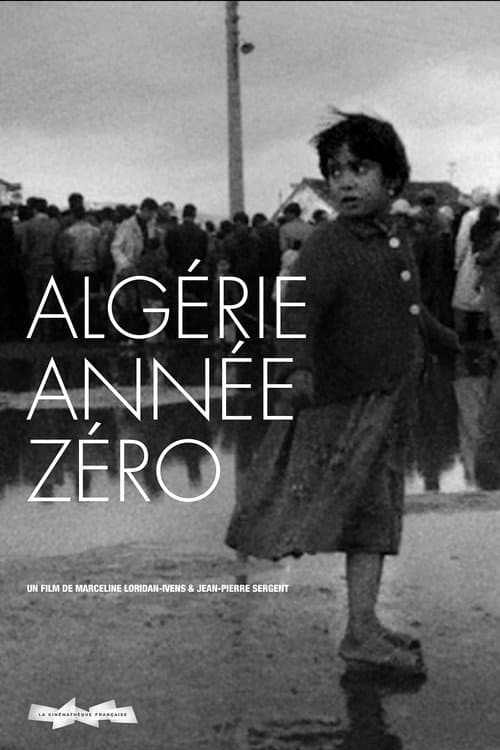
Algeria, Year Zero
10.0

Algeria, Year Zero

Oct 1, 1965

Documentary on the beginnings of Algerian independence filmed during the summer of 1962 in Algiers. The film was banned in France and Algeria but won the Grand Prize at the Leipzig International Film Festival in 1965. Out of friendship, the production company Images de France sent an operator, Bruno Muel, who later declared: "For those who were called to Algeria (for me, 1956-58), participating in a film on independence was a victory over horror, lies and absurdity. It was also the beginning of my commitment to the cinema."

The Battle of Algiers
7.9

The Battle of Algiers

Sep 8, 1966

Paratrooper commander Colonel Mathieu, a former French Resistance fighter during World War II, is sent to Algeria to reinforce efforts to squelch the uprisings of the Algerian War. There he faces Ali la Pointe, a former petty criminal who, as the leader of the Algerian Front de Liberation Nationale, directs terror strategies against the colonial French government occupation. As each side resorts to ever-increasing brutality, no violent act is too unthinkable.

Les Mains Libres
10.0

Les Mains Libres

Aug 14, 1965

In 1964, Algeria, just two years after the end of the war of independence, found itself catapulted into new contradictions, a still rural territory which responded to the modernity brought by the revolution. Filmed during the winter of 1964-1965 by the young director Ennio Lorenzini, it is the first international Algerian production which paints a rare portrait in color of a multifaceted nation, far from the simplistic vision created by the press and the French army. Produced by Casbah Film, Les Mains Libres (initially titled Tronc De Figuier) bears witness to the stigmata of colonization and the future of free Algeria throughout the Algerian territory and reveals the richness of its landscapes and the diversity of its traditions . The documentary, using the aesthetics of militant cinema of the time, is made up of four scenes: Sea and Desert, The Struggle, The Earth, Freedom.

To Be Twenty in the Aures
7.6

To Be Twenty in the Aures

May 12, 1972

A group of refractory and pacifist Bretons is sent to Algeria. These beings confronted with the horrors of war gradually become killing machines. One of them did not accept it and deserted, taking with him an FLN prisoner who was to be executed the next day.

Dark Night, October 17, 1961
7.5

Dark Night, October 17, 1961

Jun 7, 2005

Parisian authorities clash with the Front de Libération Nationale (FLN) in director Alain Tasma’s recounting of one of the darkest moments of the Algerian War of Independence. As the war wound to a close and violence persisted in the streets of Paris, the FLN and its supporters adopted the tactic of murdering French policemen in hopes of forcing a withdrawal. When French law enforcement retaliated by brutalizing Algerians and imposing a strict curfew, the FLN organizes a peaceful demonstration that drew over 11,000 supporters, resulting in an order from the Paris police chief to take brutal countermeasures. Told through the eyes of both French policemen as well as Algerian protestors, Tasma’s film attempts to get to the root of the tragedy by presenting both sides of the story.

Dreams have no titles
0.0

Dreams have no titles

Apr 23, 2022

Part of Zineb Sedira's art installation for the French Pavilion at the 59th Venice Biennale. A piece where Sedira explores her passion for the militant cinema of the 60s and 70s.

Algeria in Flames
8.5

Algeria in Flames

Jan 2, 1958

These are the first images shot in the ALN maquis, camera in hand, at the end of 1956 and in 1957. These war images taken in the Aurès-Nementchas are intended to be the basis of a dialogue between French and Algerians for peace in Algeria, by demonstrating the existence of an armed organization close to the people. Three versions of Algeria in Flames are produced: French, German and Arabic. From the end of the editing, the film circulates without any cuts throughout the world, except in France where the first screening takes place in the occupied Sorbonne in 1968. Certain images of the film have circulated and are found in films, in particular Algerian films. Because of the excitement caused by this film, he was forced to go into hiding for 25 months. After the declaration of independence, he founded the first Algerian Audiovisual Center.

The Price of Freedom
10.0

The Price of Freedom

Jul 7, 2007

In the midst of the Algerian liberation war, two characters, a meddah (traditional storyteller) and a guerrab (water distributor), having become aware of their subhuman condition in their own country, join the National Liberation Army (ALN) to fight against inhumane colonialism. They will climb the ranks to become political commissioners before falling on the field of honor, the first in a skirmish and the other in Barberousse prison (Serkadji) where he will be guillotined.

An Unhealed Wound - The Harkis in the Algerian War
10.0

An Unhealed Wound - The Harkis in the Algerian War

Sep 20, 2010

It's the unforgivable story of the two hundred thousands harkis, the Arabs who fought alongside the French in the bitter Algerian war, from 1954 to 1962. Why did they make that choice? Why were they slaughtered after Algeria's independence? Why were they abandonned by the French government? Some fifty to sixty thousands were saved and transferred in France, often at pitiful conditions. This is for the first time, the story of this tragedy, told in the brilliant style of the authors of "Apocalypse".

Cast

Daniel Costelle

Narrator (voice)

Daniel Costelle

Gérard Zwang

Self

Gérard Zwang