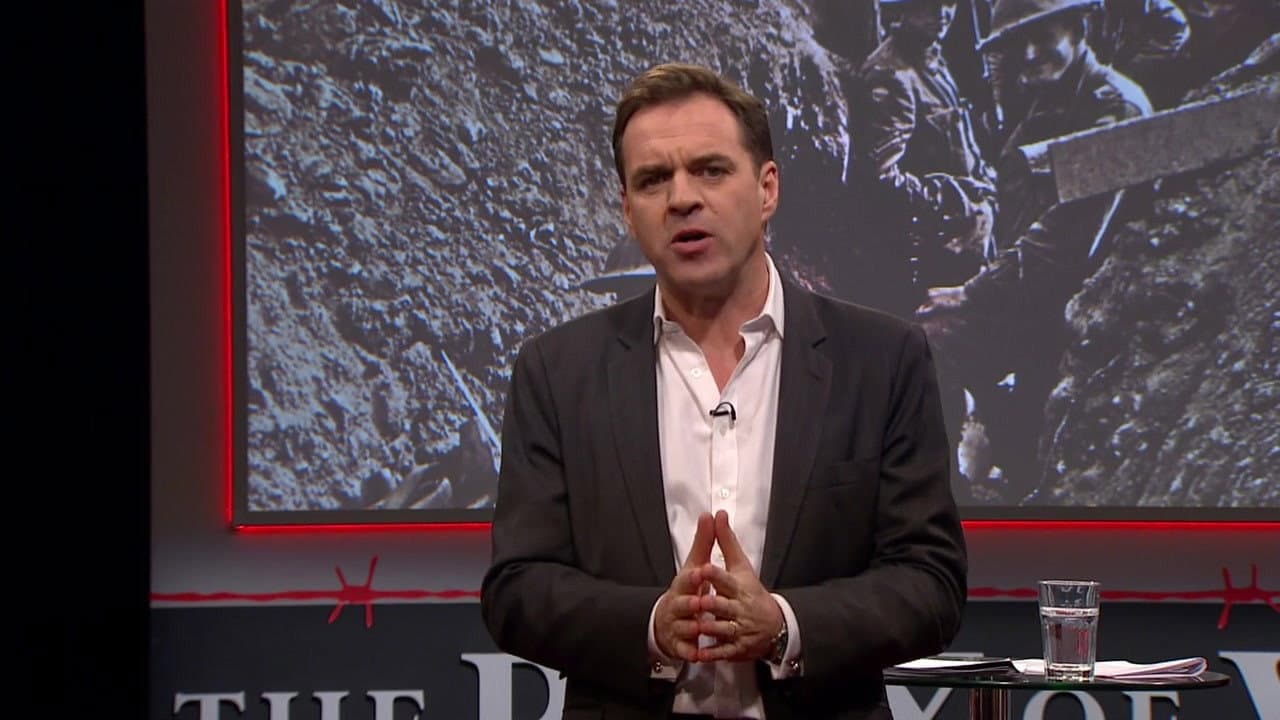
Why the Great War was a Great Mistake
Professor Niall Ferguson argues that Britain's decision to enter the First World War was a catastrophic error that unleashed an era of totalitarianism and genocide.
In 1911, a willful and determined man from peasant stock named Charles Saganne enlists in the military and is assigned to the Sahara Desert under the aristocratic Colonel Dubreuilh.
In early 20th-century Montana, Col. William Ludlow lives on a ranch in the wilderness with his sons, Alfred, Tristan, and Samuel. Eventually, the unconventional but close-knit family are bound by loyalty, tested by war, and torn apart by love, as told over the course of several decades in this epic saga.
When Queen Elizabeth's reign is threatened by ruthless familial betrayal and Spain's invading army, she and her shrewd adviser must act to safeguard the lives of her people.
In response to political pressure from Senator Lillian DeHaven, the U.S. Navy begins a program that would allow for the eventual integration of women into its combat services. The program begins with a single trial candidate, Lieutenant Jordan O'Neil, who is chosen specifically for her femininity. O'Neil enters the grueling Navy SEAL training program under the command of Master Chief John James Urgayle, who unfairly pushes O'Neil until her determination wins his respect.
Three stories told simultaneously in ninety minutes of real time: a Republican Senator who's a presidential hopeful gives an hour-long interview to a skeptical television reporter, detailing a strategy for victory in Afghanistan; two special forces ambushed on an Afghani ridge await rescue as Taliban forces close in; a poli-sci professor at a California college invites a student to re-engage.
In this remake the Bertolucci's 1900, Olmo Dalco and Alfredo Berlingheiri's complicated friendship and struggles with the constantly changing political scope are chronicled as well as the rise of fascism and the communist revolution.
Paris, France, during the First World War. While thousands of soldiers die every day on the battlefields, Henri Landru, a seemingly respectable furniture dealer, married and father of four children, relentlessly feeds his own sinister factory of death.
A history of the French Revolution beginning from the decision of the king to convene the Etats-Generaux in 1789 in order to deal with France's debt problem. Part one spans the event until August 10, 1792 (when the King Louis XVI lost all authority and was imprisoned). Part two carries the story through the end of the terror in 1794.
A Danish officer, Michael, is sent away to the International Security Assistance Force operation in Afghanistan for three months. His first mission there is to find a young radar technician who had been separated from his squad some days earlier. While on the search, his helicopter is shot down and he is taken as a prisoner of war, but is reported dead to the family.
The story, starring Constance Bennett and Douglass Montgomery, involves a Canadian POW being hidden by a German citizen during World War I.
A comic study of 20th-century history, reconstructing the life of writer, creator and professional prisoner Tulse Luper. Born in 1911 Newport and last heard of in 1989, Luper’s life is pieced together from the evidence found in 92 suitcases scattered across the globe. In the first of three parts, we follow Luper through three distinct episodes: as a child during the First World War; as an explorer in Mormon Utah; and as a writer in Belgium during the rise of fascism.
Shortly after the United States enters World War I in 1917, a Broadway actress agrees to let a naive soldier court her in order to impress his friends, but a real romance soon begins.
The story of an idle rich boy who joins the US Army's Rainbow Division and is sent to France to fight in World War I, becomes friends with two working class men, experiences the horrors of trench warfare, and finds love with a French girl.
In the midst of the Spanish Civil War, the rise of anarcho-syndicalism brings Frederica Montseny into the Republic’s government. She reluctantly accepts the position to prevent the spread of fascism, becoming the first female minister in Spain — and in Europe. After the war, Montseny is forced into exile in France, where she faces an extradition trial that puts her firm convictions to the test.
The enigma of the personality cult is revealed in the grand spectacle of Stalin’s funeral. The film is based on unique archive footage, shot in the USSR on March 5 - 9, 1953, when the country mourned and buried Joseph Stalin.
In Montauban in 1944, Julien Dandieu is a surgeon in the local hospital. Frightened by the German army entering Montauban, he asks his friend Francois to drive his wife and his daughter in the back country village where Julien has an old castle. One week later, Julien decides to meet them for the week end, but the Germans are already occupying the village.
No overview available.
A young Catholic priest from Boston confronts bigotry, Nazism, and his own personal conflicts as he rises to the office of cardinal.
This is a rare look at one of the worst horror stories in the long infamous history of warfare. This series features captured German and Russian film footage, much of which has never been seen before. For decades the Cold War prevented us from looking closely at what really happened between the Russians and the Germans on the Eastern Front during World War II. More than a struggle between nations, it pitted maniacal tyrant against maniacal tyrant, evil ideology against evil ideology. The lives of tens of millions of human beings were consumed by its raging hatreds and appalling indignities. One in every ten Russians died. One in every four Poles died. Whole divisions of Italians, Romanians, Hungarians disappeared with barely a trace. An average of 17,800 people died on every single day and this, the war on the Russian German Front, lasted for 1,400 days. This series features captured German and Russian film footage, much of which has never been seen before.
In 1917, the First World War is raging. Julien is from Luxemburg, so instead of having to go to war he studies piano in Paris. One day his friend Jacques, also a musician and now a fighter pilot on the front, invites him to spend a few days in his family's empty house in Bray. The housekeeper, a beautiful stoic woman lets Julien in, but his friend is late and he is obliged to wait. In the meantime, he starts reminiscing of the pre-war days spent with his friend and Jacques' girlfriend Odile.
Self - Presenter
No Trailers found.