No Trailers found.
Intérprete
No overview available.
The encounter with a growing, and mostly undocumented, brazilian community allows us to bear witness to its energy, its vivacity, and its diversity. This film attempts to work for a larger acceptance of foreigners in their land of exile.
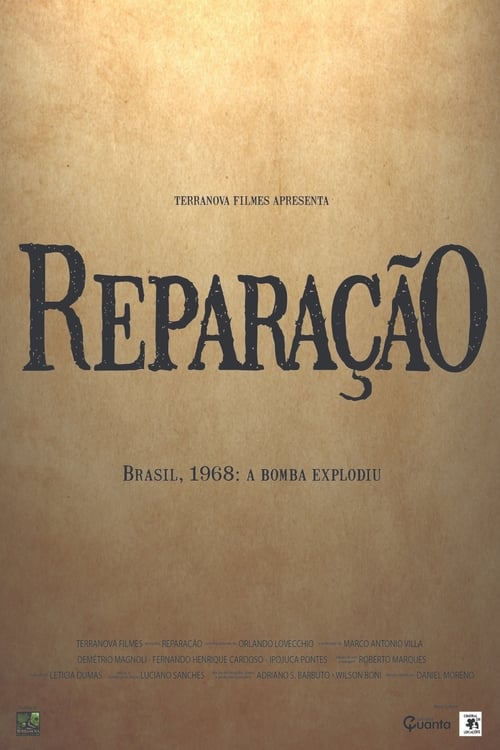
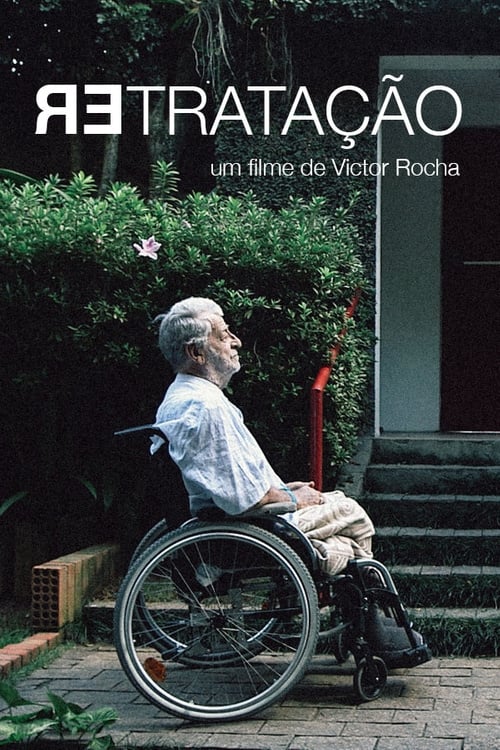
In 1968, Orlando Lovecchio was made victim of a guerilla's bomb terrorist attack, which main objective was to fight against the Military Regime. Orlando lost one leg after the world-reckoned attack against the U.S. Consulate in Sao Paulo.
This documentary highlights the evolution of Brazil's Circo Voador venue from homespun artists' performance space to national cultural institution.
The work mediated by digital apps and platforms is growing worldwide. But the advance of the “gig economy”, called in Brazil “uberization”, has aroused debates about the precariousness and intensification of work.
The cinema of Pernambuco is considered one of the most complex components of Brazilian cinema, particularly for its potency and creative style. The presence of women in filmmaking seldom holds the same historical notoriety as that of men, and the Pernambuco scene is no exception. In the context of "Amor, Plástico e Barulho" (Love, Plastic, and Noise), we find a film that serves as a testament to the marginalization of women in the creative industry, intertwining themes of consumption and the production of brega music. Hence, we use "Feminino e Barulho" (Feminine and Noise) as a means to share what we've learned. Renata Pinheiro has inspired us to craft a narrative that gives voice to those who need to be heard. We are here to showcase a glimpse of them and what they represent. "Feminino e Barulho" is a short film about love, femininity, sisterhood, and empowerment.
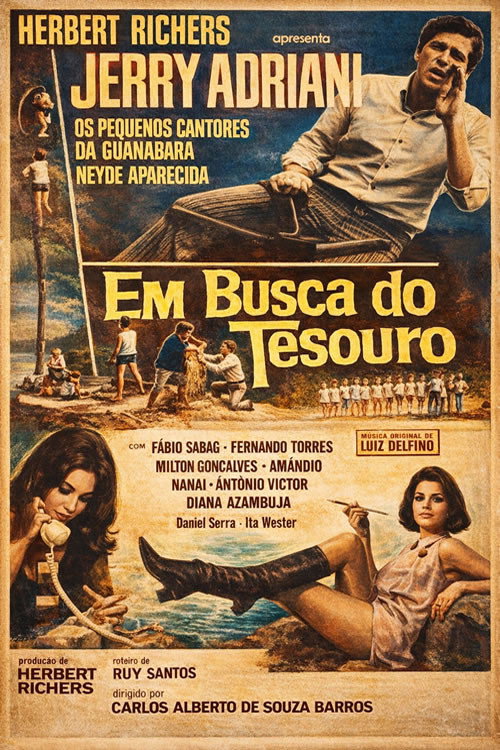
Jerry is a tutor at an orphanage. On the first day of vacation, the boys go to the beach with Professor Teobaldo and find a skeleton and a treasure map. Word spreads and a rush for gold begins. On the one hand, Jerry and Neyde, television colleagues; on the other, the director of the station, Indalécio, and his lover Aphrodite; finally, the evil Rock Trombada, in the company of scientist Bertini and Daniel. On Treasure Island, the three camps promote mutual sabotage. After many confusions, Trombada flees with the treasure to the ship's cemetery but they are surrounded by the boys and Indalécio. It's the final war. But it is Jerry who will take the wealth in order to improve the situation at the orphanage.
Documentary addressing the composer Cartola and the transformations that took place in Morro Carioca and in Samba during his life. Founder of the Escola de Samba Estação Primeira de Mangueira, Cartola has his life and his music marked by his community and his School, far from the city His school, created as a playful and expressive center for the mangueirense, has now become a point of tourist attraction. This made work possible for the inhabitants of the hill, but it transformed the spirit of samba and its aesthetics.
A documentary that exposes the shocking truths behind industrial food production and food wastage, focusing on fishing, livestock and crop farming. A must-see for anyone interested in the true cost of the food on their plate.
A whimsical blend of live action and animation, "Saludos Amigos" is a colorful kaleidoscope of art, adventure and music set to a toe-tapping samba beat. From high Andes peaks and Argentina's pampas to the sights and sounds of Rio de Janeiro, your international traveling companions are none other than those famous funny friends, Donald Duck and Goofy. They keep things lively as Donald encounters a stubborn llama and "El Gaucho" Goofy tries on the cowboy way of life....South American-style.
Amid the civil-military dictatorship implanted with the 1964 coup, Sergio Muniz had the idea of making a documentary about the action of the Death Squad. At the time, the press still had some freedom to disseminate the work of these death squads formed by police officers of various ranks, and that he acted on the outskirts of cities like Sao Paulo and Rio de Janeiro. The victims of police repression (as today) were men, poor and black, and this condition is supposed criminals.
Fernando Lemos, a Portuguese surrealist artist, fled from dictatorship to Brazil in 1952 searching for something better. The movie follows the last moments of his journey and the struggle for the preservation of his legacy, trying to fulfill his last great desire: to be a good dead man.
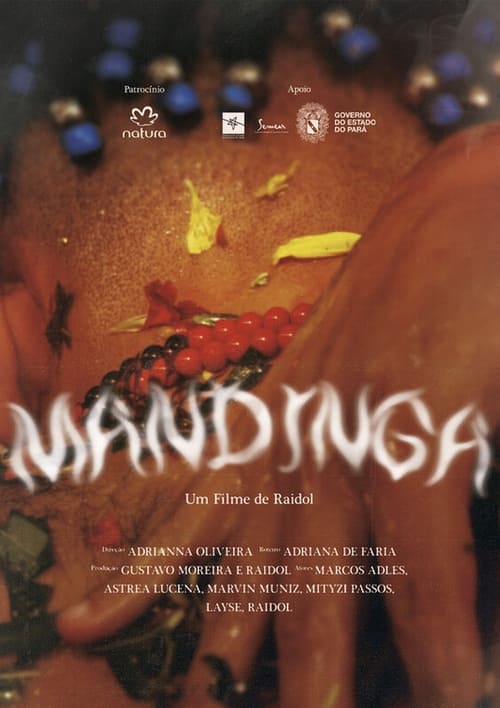
Benedito wakes up for another day of work as a motorcycle courier. Cradled by Raidol's Mandinga and guided by his Orishas, he receives mysterious deliveries to leave them at a final destination but the paths that open up go far beyond his everyday reality.
Documentary about the victorious German national football team - called "Die Mannschaft" - and their journey to the 2014 FIFA World Cup in Brazil.
Celebrating 50 years of her career, Maria Bethânia filmed in Brazil in 2105 the show Abraçar e Agradecer, which now comes out on CD and DVD.
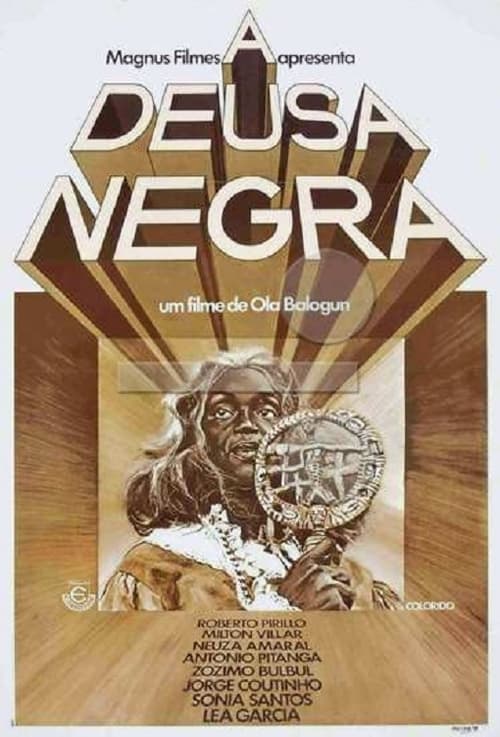
A Deusa Negra is a love story that spans two centuries. In 18th century Yorubaland, Prince Oluyole is taken prisoner in the course of internecine warfare fanned by overseas slave traders. He is sold into slavery in Brazil. In present day Nigeria, at his father's deathbed, the young Babatunde promises to go to Brazil and search for traces of their once-enslaved ancestors. Beginning with a Candomblé ritual, his journey takes him ever deeper into this culture and, in a dream-like sequence, affords him a deeper understanding of his ancestors' suffering and powers of resistance. Balogun effortlessly links present with past, real with magical worlds and discourse with trance. The hypnotic atmosphere is also heightened by the music of the Nigerian drummer Remi Kabaka, which plays with repetitive patterns and distortions.
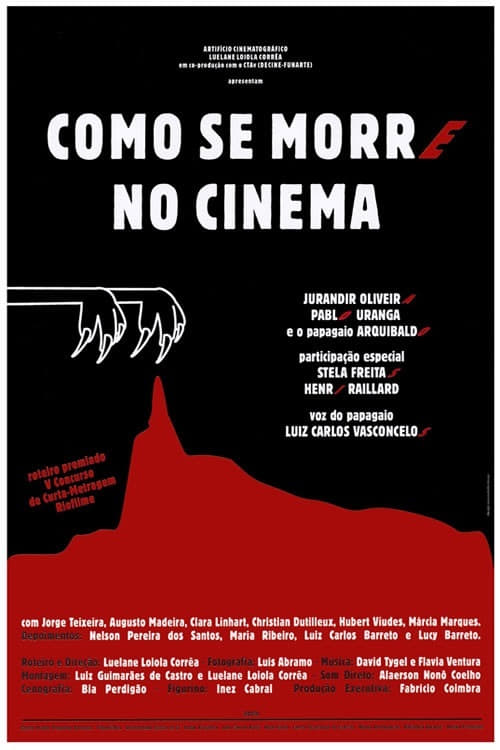
Memories of a parrot who participated in the filming of the classic Vidas Secas, in 1962, where it was featured along the puppy Baleia.
The impeachment and removal from office of Brazilian President Dilma Rousseff in 2016 was triggered by a corruption scandal involving, among others, her then vice-president Michel Temer. Director Maria Augusta Ramos follows the trial against Rousseff from the point of view of her defence team. This is a courtroom drama that unfolds slowly: the appearances of the various parties gradually turn the proceedings into something akin to theatre. Inside the courtroom, grand emotions are played to full effect whilst, on the other side of the doors, lobbyists and supporters pace the corridors. Meanwhile, outside, in front of Brasília’s modernist government buildings, demonstrators are chanting like a Greek chorus. Only the main character, Rousseff herself, remains professional and aloof.