logologo
MovieVerse© 2024
Privacy PolicyTerms of ServiceContact Us
Made with ❤️ by Thathsara
movie poster
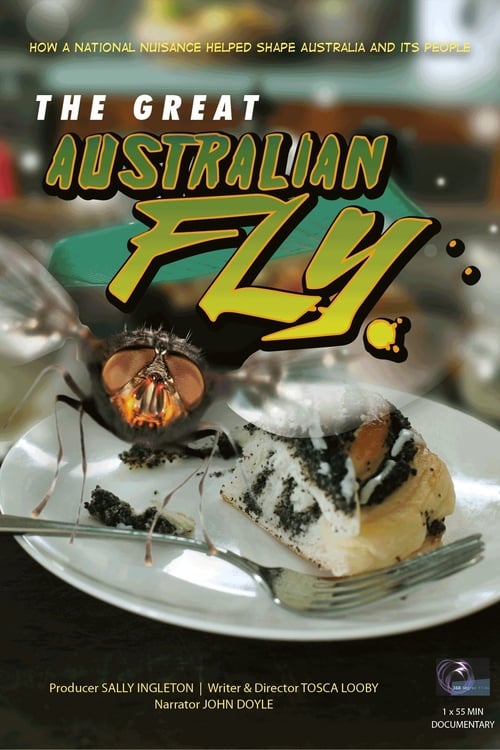
The Great Australian Fly
Sign in to create your own watchlist

The Great Australian Fly

Mar 25, 2014
0h 57m
★ 0.0

How a national nuisance helped shape Australia and its people.

Overview

THE GREAT AUSTRALIAN FLY looks at how a national nuisance has shaped Australia and its people, confounding our scientists, influencing our lifestyle and defining the way we speak. But is its value misunderstood? The one-hour documentary explores how this much-maligned spoiler of the Australian summer is in fact a crime solver, healer, pollinator and street sweeper. We'd miss them if they were gone, yet we put huge amounts of energy into wiping them out. Is it time to call a truce? Directed by Tosca Looby and produced by Sally Ingleton, the amusing and intriguing film pays homage to a much-maligned invertebrate and the influence it has had on our world.

Genres

Documentary

Production Companies

360 Degree Films

Cast

No Cast found.

The Great Australian Fly Trailers

No Trailers found.

You may also like

A Night with the Stars
8.0

A Night with the Stars

Dec 18, 2011

For one night only, Professor Brian Cox goes unplugged in a specially recorded programme from the lecture theatre of the Royal Institution of Great Britain. In his own inimitable style, Brian takes an audience of famous faces, scientists and members of the public on a journey through some of the most challenging concepts in physics. With the help of Jonathan Ross, Simon Pegg, Sarah Millican and James May, Brian shows how diamonds - the hardest material in nature - are made up of nothingness; how things can be in an infinite number of places at once; why everything we see or touch in the universe exists; and how a diamond in the heart of London is in communication with the largest diamond in the cosmos.

Thrive: What on Earth Will it Take?
5.8

Thrive: What on Earth Will it Take?

Nov 11, 2011

An unconventional documentary that lifts the veil on what's really going on in our world by following the money upstream - uncovering the global consolidation of power in nearly every aspect of our lives. Weaving together breakthroughs in science, consciousness and activism, THRIVE offers real solutions, empowering us with unprecedented and bold strategies for reclaiming our lives and our future.

Meteors
4.7

Meteors

Jun 13, 1947

Stones from the sky - tangible pieces of other worlds. After millions of years of wandering in the darkness and the cold expanses of space, meteorites find shelter in the windows of museums. By studying meteorites, scientists know their origins, how they get to the Earth, and from which substances they are comprised. This film also explores the attitude towards this phenomenon in different nations through different times in history.

Our Friend the Atom
6.7

Our Friend the Atom

Jan 23, 1957

Dr. Heinz Haber, a noted scientist in the field of atomic energy, hosts this look at the possibility of an exciting new power source. He starts by comparing atomic energy to a genie in a bottle, both of which capable of doing both good and evil, and it is up to humankind to develop safe controls over this largely unexplored science.

Brainman
7.5

Brainman

Nov 9, 2005

Daniel Tammet has autism. He is also a savant. He can perform mind-boggling mathematical calculations at breakneck speeds. But unlike other savants, who can perform similar feats, Tammet can describe how he does it. He speaks seven languages and is even devising his own language. Now scientists are asking whether his exceptional abilities are the key to unlock the secrets of autism. This documentary follows Daniel as he travels to America to meet the scientists who are convinced he may hold the key to unlocking similar abilities in everyone. He is challenged to learn Icelandic, one of the world’s hardest languages, in just one week. Will Daniel do it? And what can we learn from this prodigious talent?

The Mermaids' Tears: Oceans of Plastic
8.0

The Mermaids' Tears: Oceans of Plastic

May 21, 2009

Every km of ocean now contains an average of 74,000 pieces of plastic. A 'plastic soup' of waste, killing hundreds of thousands of animals every year and leaching chemicals slowly up the food chain. In Holland, scientists found plastic in the stomachs of 95% of all fulmar birds. In Germany, plastic has been found to affect the reproductive systems of animals, while in the US, conservationists are seeing increasing numbers of dolphins die in agony, their guts blocked with rubbish. What will be the long term impact of this 'plastic pollution'? Can anything be done to clean up our oceans?

Cosmic Zoom
6.0

Cosmic Zoom

Feb 2, 1968

This short animation transports us from the farthest conceivable point of the universe to the tiniest particle of existence, an atom of a living human cell. The art of animation and animation camera achieve this exhilarating journey with a freshness and clarity. Without words.

In The Womb: Animals
10.0

In The Womb: Animals

Dec 10, 2006

Using 4-D technology, the early stages of a Golden Retriever puppy, a dolphin, and an elephant are examined.

No Image Available
9.5

Frames of Reference

Jan 1, 1960

An educational physics film utilizing a fascinating set consisting of a rotating table and furniture occupying surprisingly unpredictable spots within the viewing area, Leacock’s Frames of Reference (1960), features fine cinematography by Abraham Morochnik, and funny narration by University of Toronto professors Donald Ivey and Patterson Hume, in a wonderful example of the fun a creative team of filmmakers can have with a subject other, less imaginative types might find pedestrian.

The Violent Universe
0.0

The Violent Universe

Apr 11, 1969

Thirty distinguished astronomers are visited at their observatories throughout the world in this comprehensive report of astronomical theories, research, and discoveries.

The Mayo Clinic
7.0

The Mayo Clinic

Sep 25, 2018

The Mayo Clinic tells the story of a unique medical institution that has been called a "Medical Mecca," the "Supreme Court of Medicine," and the "place for hope where there is no hope." The Mayo Clinic began in 1883 as an unlikely partnership between the Sisters of Saint Francis and a country doctor named William Worrall Mayo after a devastating tornado in rural Minnesota. Since then, it has grown into an organization that treats more than a million patients a year from all 50 states and 150 countries. Dr. Mayo had a simple philosophy he imparted to his sons Will and Charlie: "the needs of the patient come first." They wouldn't treat diseases...they would treat people. In a world where healthcare delivery is typically fragmented among individual specialties, the Mayo Clinic practices a multi-specialty, team-based approach that has, from its beginnings, created a culture that thrives on collaboration.

SEVEN
8.8

SEVEN

Dec 8, 2020

What caused Building 7 to collapse on 9/11? Dr. Leroy Hulsey from the University of Alaska Fairbanks may have the answer, following an exhausting four year engineering study.

Carnivorous Plants
2.0

Carnivorous Plants

Jan 1, 1955

Photomicrography reveals the unusual structure and behavior of the Venus's flytrap, the trumpet plant, the cobra plant, the common pitcher plant, the sundew plant and the utricularia.

Synthetic Pleasures
4.5

Synthetic Pleasures

Sep 13, 1995

Conceived as an electronic road movie, this documentary investigates cutting edge technologies and their influence on our culture as we approach the 21st century. It takes off from the idea that mankind's effort to tap the power of Nature has been so successful that a new world is suddenly emerging,an artificial reality. Virtual Reality, digital and biotechnology, plastic surgery and mood-altering drugs promise seemingly unlimited powers to our bodies, and our selves. This film presents the implications of having access to such power as we all scramble to inhabit our latest science fictions.

No Image Available
0.0

Rocketships

Jan 1, 1998

A look back at the origins of rocket science and forward to the cutting edge technology of reusable rockets and shuttles. Using computer animation, the program also explores the future of space travel that may some day carry commercial passengers or "tourists" into space.

No Image Available
0.0

Secret Satellite

Aug 25, 1996

Documentary that explores the birth and growth of satellite espionage.

No Image Available
2.8

A Universe from Nothing

Oct 3, 2009

Lawrence Krauss gives a talk on our current picture of the universe, how it will end, and how it could have come from nothing. Krauss is the author of many bestselling books on Physics and Cosmology, including "The Physics of Star Trek."

Who's Out There?
6.3

Who's Out There?

Jan 1, 1975

Orson Welles — with contributions from scientists George Wald, Carl Sagan, and others — examines the possibility and implications of extraterrestrial life. In examining our perceptions of alien 'martians' from his "War of the Worlds" broadcast, to then-modern explorations of Mars, this film from NASA provides a unique glimpse at life on earth, and elsewhere in the universe.

Human Nature
6.8

Human Nature

Mar 12, 2019

The biggest tech revolution of the 21st century isn’t digital, it’s biological. A breakthrough called CRISPR gives us unprecedented control over the basic building blocks of life. It opens the door to curing disease, reshaping the biosphere, and designing our own children. This documentary is a provocative exploration of CRISPR’s far-reaching implications, through the eyes of the scientists who discovered it, the families it’s affecting, and the genetic engineers who are testing its limits.

No Image Available
6.0

X-rays

Nov 4, 1937

This short documentary presents an early scientific visualization of X-ray technology, documenting the discovery of Röntgen rays and their application in medical diagnostics. Through staged demonstrations and instructional imagery, the film illustrates the principles of radiographic imaging and its emerging role in modern medicine.