The agriculture reforming process, after the 1974 revolution, is seen through an analysis of the social structures and class struggles of the Portuguese society.
No Trailers found.
No Cast found.
The people, the scenery and the industrial traditions of the Stroud valley and the growth of the woollen industry.
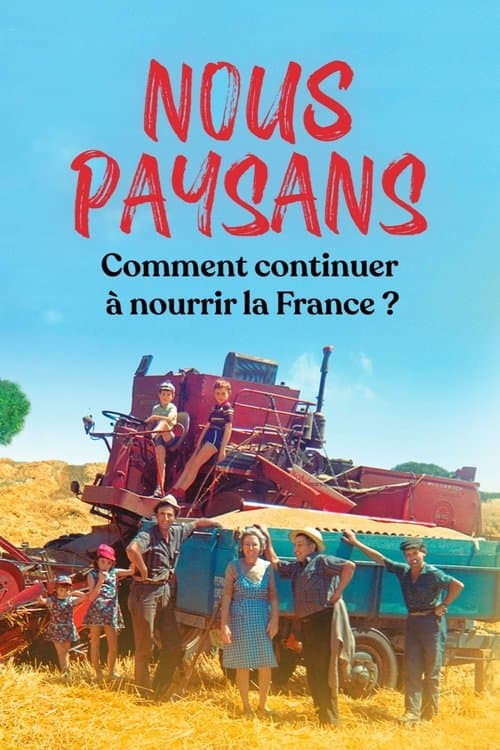
In barely a century, French peasants have seen their world profoundly turned upside down. While they once made up the vast majority of the country, today they are only a tiny minority and are faced with an immense challenge: to continue to feed France. From the figure of the simple tenant farmer described by Emile Guillaumin at the beginning of the 20th century to the heavy toll paid by peasants during the Great War, from the beginnings of mechanization in the inter-war period to the ambivalent figure of the peasant under the Occupation, From the unbridled race to industrialization in post-war France to the realization that it is now necessary to rethink the agricultural model and invent the agriculture of tomorrow, the film looks back at the long march of French peasants.
For almost three years, nature filmmaker and ecologist David Cebulla has been observing wild Common hamsters. He not only tries to learn more about the species, but also documents why hamsters are globally threatened with extinction. David travels from the western border of the distribution area in France via Germany, Poland, Austria and Hungary to the eastern border of the distribution area in the Kazakh steppe. In the process, he manages to capture some unique and fantastic images. But during the project, it becomes increasingly difficult to find animals living in the wild.
Mustafa Kemal Atatürk (1881-1938) was a Turkish field marshal, revolutionary statesman, author, and the founding father of the Republic of Turkey, serving as its first president from 1923 until his death in 1938.
The silent majority is the Costa Rican peasantry, which has been the object of traditional contempt and which has manifested itself in various forms: unfair salary compensation, bad prices for their agricultural products, financing difficulties, land grabs, precarious housing and educational conditions. health. Precariousness, peasant migrations and the depletion of the agricultural frontier are also analyzed in the film.
Patrick Kielty explores the untold story of Harry Ferguson and Henry's Ford's remarkable handshake agreement and how it led to a $250 million lawsuit.
The Heroes of the Massacre River is a powerful documentary that chronicles the stories of the pioneers behind the construction of the historic Canal of Ouanaminthe, a project that united Haitians across the nation and the diaspora. This film celebrates the groundbreaking efforts of key figures, centering on Dr. Bertrhude Albert, Dr. Naismy-Mary Fleurant, architect Wideline Pierre, economist Etzer Emile as well as dedicated canal workers Milourie Sylfrard, Theodore Johnson and Joseph Pressoir — all guided by the investigative journey of Max Angie Clervil. It also serves as a commentary on the complexity of colonialism and borders, tracing the role that the Massacre River continues to play in the history of Ayiti.
No overview available.
October 2014. Ouagadougou, the capital of Burkina Faso, is the scene of an unarmed uprising that ousts the dictator in power since 1987 and later staves off an attempted coup. In 2015, the country votes freely for the first time in its history, yet real change remains allusive, especially regarding ongoing economic exploitation by foreign companies. In one year of struggle and resistance, the film follows the daily life of four Burkinabes: a musician and leader of the revolution, a local political candidate, a miner engaged in the labor movement, and an impoverished mother, all sharing hopes that the elections will change the country’s path.
This short film serves as a cautionary tale to farmers who recklessly cut down trees on their land. When prairie farmers engaged in this practice to facilitate plowing, they discovered that the trees had served as windbreaks protecting top soil from erosion. The Dominion Department of Agriculture's experimental station at Indian Head, Saskatchewan, cultivated acres of young trees for distribution to farmers.
In 1979, a revolution in Iran. In 1980, a revolution in Poland. The fall of the Shah, the “King of Kings,” in Iran. Mass strikes and the foundation of Solidarność (Solidarity) in Poland. What was in the minds of the young women and men who fomented revolution in their own country? What did they think when their revolution was quelled, or – as in Iran – an authoritarian regime was instituted under the name of an “Islamic Republic”?
Railroad of Hope consists of interviews and footage collected over three days by Ning Ying of migrant agricultural workers traveling from Sichuan in China's interior, to the Xinjiang Autonomous Region, China's northwest frontier.[1] Through informal interviews aboard the cramped rail cars, Ning Ying explores the hopes and dreams of the workers, many of whom have never left their homes before.
Half blind and half deaf, ostraziced Cuban writer Rafael Alcides tries to finish his unpublished novels to discover that after several decades, the home made ink from the typewriter he used to write them has faded. The Cuban revolution as a love story and eventual deception is seen through the eyes of a man who is living an inner exile.
An organic farmer in Maine sets out to transform the prison food system. Seeds of Change captures the intersecting stories of life-long farmer Mark McBrine and several incarcerated men as they harvest their own meals from a five-acre prison garden unlike any other.
A personal essay which analyses and compares images of the political upheavals of the 1960s. From the military coup in Brazil to China's Cultural Revolution, from the student uprisings in Paris to the end of the Prague Spring.
Set during the Lebanese revolution, WE NEVER LEFT portrays a heart-wrenching duality between Beirut and New York, an impassioned testament to the Lebanese diaspora’s unrequited but irrepressible love for their homeland.
These are strange times indeed. While they continue to command so much attention in the mainstream media, the 'battles' between old and new modes of distribution, between the pirate and the institution of copyright, seem to many of us already lost and won. We know who the victors are. Why then say any more?
King Corn is a fun and crusading journey into the digestive tract of our fast food nation where one ultra-industrial, pesticide-laden, heavily-subsidized commodity dominates the food pyramid from top to bottom – corn. Fueled by curiosity and a dash of naiveté, two college buddies return to their ancestral home of Greene, Iowa to figure out how a modest kernel conquered America. With the help of some real farmers, oodles of fertilizer and government aide, and some genetically modified seeds, the friends manage to grow one acre of corn. Along the way, they unlock the hilarious absurdities and scary but hidden truths about America’s modern food system in this engrossing and eye-opening documentary.
Documentary filmmaker Robert Kenner examines how mammoth corporations have taken over all aspects of the food chain in the United States, from the farms where our food is grown to the chain restaurants and supermarkets where it's sold. Narrated by author and activist Eric Schlosser, the film features interviews with average Americans about their dietary habits, commentary from food experts like Michael Pollan and unsettling footage shot inside large-scale animal processing plants.
At first glance, Matthew VanDyke—a shy Baltimore native with a sheltered upbringing and a tormenting OCD diagnosis—is the last person you’d imagine on the front lines of the 2011 Libyan revolution. But after finishing grad school and escaping the U.S. for "a crash course in manhood," a winding path leads him just there. Motorcycling across North Africa and the Middle East and spending time as an embedded journalist in Iraq, Matthew lands in Libya, forming an unexpected kinship with a group of young men who transform his life. Matthew joins his friends in the rebel army against Gaddafi, taking up arms (and a camera). Along the way, he is captured and held in solitary confinement for six terrifying months.