The construction of the Obelisco in Buenos Aires, Argentina.
No Cast found.
Architecture in Beirut was the second greatest victim of the civil war, with pages of ancient and modern history erased by the end of the conflict. This documentary interviews citizens calling for a reconstruction plan that would preserve Beirut’s spirit of culture and openness.
In 1967, de Andrade was invited by the Italian company Olivetti to produce a documentary on the new Brazilian capital city of Brasília. Constructed during the latter half of the 1950s and founded in 1960, the city was part of an effort to populate Brazil’s vast interior region and was to be the embodiment of democratic urban planning, free from the class divisions and inequalities that characterize so many metropolises. Unsurprisingly, Brasília, Contradições de uma Cidade Nova (Brasília, Contradictions of a New City, 1968) revealed Brasília to be utopic only for the wealthy, replicating the same social problems present in every Brazilian city. (Senses of Cinema)
The Baselstrasse is a street in Lucerne. People call it "Rue de Blamage" – it's a noisy street tucked into a narrow space between a hill and a train track. The people who live here don't usually mingle with the rich and famous, but even the roughest haunt can be a home to those who live and work there – and Baselstrasse's two kilometers of asphalt are no different.
After filming the construction site of the Berlitz Palace (2nd), Pierre Chenal shows us in contrast other contemporary architectural achievements which, using the same technical processes, do not sacrifice the structure of iron and concrete for decoration. A documentary to the glory of the modern designs of Mallet-Stevens and Le Corbusier.
A short film about traditional crafts and culture that can still be found in the Wallachian mountains today.
No overview available.
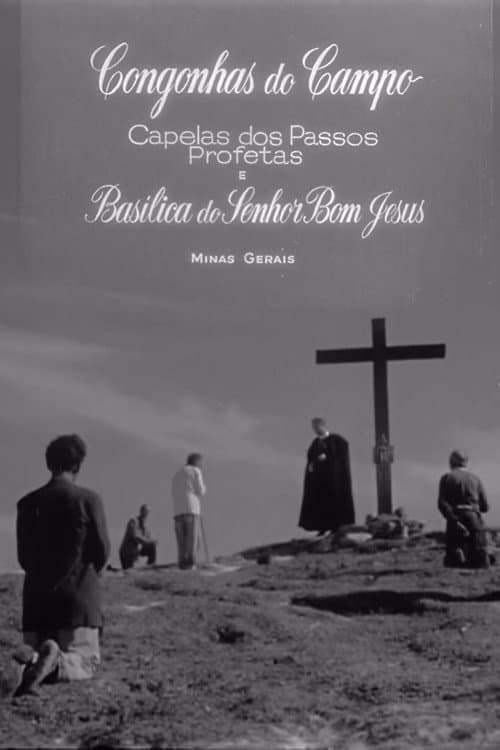
Aspects of the city of Congonhas do Campo. The preponderance of baroque architecture, the Basilica of Senhor Bom Jesus de Matozinho, the six chapels on the terrace leading to Morro do Maranhão. Each chapel contains statues representing moments of the Passion of Christ. While in the first chapel there is Santa Ceia figuration, in the second there is the Passo Horto scene. The kiss of betrayal and the imprisonment of Christ before the scene of the third chapel. In the fourth, two scenes are gathered: the coronation and the flagellation. On the fifth, the Christ bears the cross and the crucifixion is featured in the sixth chapel. The twelve apostles of Aleijadinho and the Latin inscriptions of each one. The interior of the Basilica and its main altar, with the figure of the Lord Dead.
A docu-art film about Kyiv and the contemporary problems of the capital. The film raises the issue of the dilapidated state of Kyiv's old buildings and the search for effective mechanisms to preserve the city's architectural heritage.
On the night of July 19, 1977, Inés was traveling by bus when a military patrol detained all the passengers. That morning, almost everyone was released except Inés. Her father began a never-ending search that led him to the very center of Argentina's repressive apparatus. The judicial path and the love of a family that never stops.
A group of young architects, confined to a forest in Barcelona during the COVID crisis, explore the problems generated by the ambition of wanting to be completely self-sufficient.
This documentary explores the complexities of Los Angeles. Blending a highly structured montage of shots exploring the city with interviews of students, the writer Henry Miller, and residents from all communities, this evocation of Angelenos' city paints a portrait of a living, constantly evolving entity.
Greek internal migrants in Athens, after the Greek Civil War colonize the tops of the Tourkovounia hills.
Documentary about the life and work of Jorge Luis Borges, from his own memories and reflections.
Ladies of good families and social standing come to have their afternoon tea with their daughters who will someday follow in the same tradition. A charming portrait of a time that is slowly disappearing.
Since the end of World War II, one of kind of urban residential development has dominate how cities in North America have grown, the suburbs. In these artificial neighborhoods, there is a sense of careless sprawl in an car dominated culture that ineffectually tries to create the more organically grown older communities. Interspersed with the comments of various experts about the nature of suburbia
Diego Tejerina, a prisoner with temporary releases, uses his knowledge of sociology to reflect on freedom and confinement.
The New Tango (El Nuevo Tango) was not shown in Argentina for a long time as it deals with the ascent of Argentinean president Hector Campora in May 1973, and features Cuban and Chilean presidents, Osvaldo Dorticos and Salvador Allende. A million people gathered on the Plaza de Mayo to acclaim the new President. One of Cámpora's first presidential actions was a granting of amnesty to political prisoners who where jailed during the dictatorship. On 28 May Argentina restored diplomatic relations with Cuba, which then received Argentine aid - such as food and industrial products - to break the United States embargo against Cuba.
In 1959 Hiroshi Teshigahara shot the following 16 mm footage of he and his father’s first trip to Barcelona and the outlying Catalonian countryside, including a visit to the home of Salvador Dali in Port Lligat. The footage was recorded without sound.
No Trailers found.