The story of Daedalus and Icarus
No Cast found.
No Trailers found.
A cartoon version of the Greek myth of Labyrinth.
Olympus. Here are all the most important gods: mighty Zeus, his treacherous wife Hera, handsome singer Apollo, ruler of the seas Poseidon, warrior Ares, goddess of beauty and love Aphrodite and wise Athena. Here is the illegitimate son of Zeus, Hercules - a demigod-half-man. Having missed the Earth, he begs for travel on it from Zeus before sunrise. He is accompanied by an eagle - a cunning and insinuating creature, the same one who once pecked Prometheus and from which Hercules saved him. On Earth, Hercules enters the temple dedicated to him and his twelve feats. There he remembers some of them.
The cunning king Polidekt of the island of Serif sends the young hero Perseus to get the head of Gorgon Medusa, whose gaze turns people to stone. He is accompanied by the god of commerce and profits and the patron of thieves and athletes, Hermes, who pursues his personal interests. Perseus gets the head of Medusa, but uses it to save Andromeda, the daughter of King Kef.
The story of the titan Prometheus, who stole fire from Olympus for people and was severely punished for this by Zeus: Prometheus' friend the blacksmith Hephaestus was forced to chained him to the rock, and every day the eagle that flew from Olympus pecked the recovering liver of Prometheus. But the agony of Prometheus was not in vain - people preserved his sacred gift.
Pioneer of silhouette animation, Lotte Reiniger, uses this technique in a retelling of the Greek legend in which the sculptor, Pygmalion, brings a statue to life.
In a time of superstition and magic, when wolves are seen as demonic and nature an evil to be tamed, a young apprentice hunter comes to Ireland with her father to wipe out the last pack. But when she saves a wild native girl, their friendship leads her to discover the world of the Wolfwalkers and transform her into the very thing her father is tasked to destroy.
A year after losing her mother, a young girl learns that she must journey across Japan to the annual gathering of gods in the sacred land of Izumo.
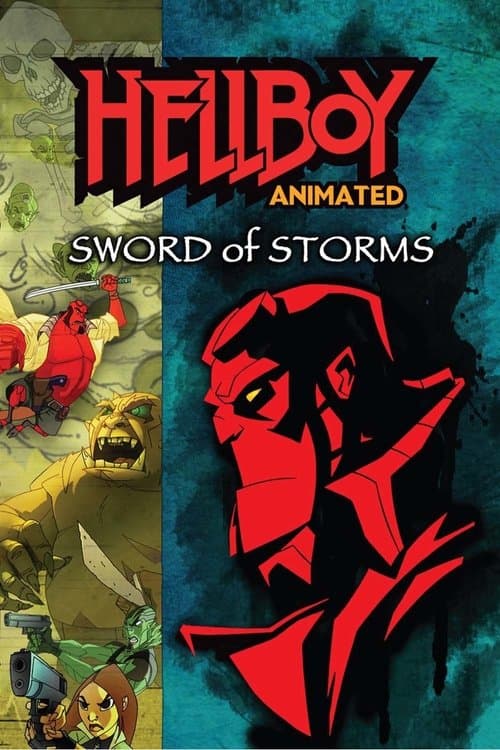
A folklore professor becomes unwittingly possessed by the ancient Japanese demons of Thunder and Lightning. But when The Bureau of Paranormal Research & Defense dispatches a team of agents to investigate, a cursed samurai sword sends Hellboy to a supernatural dimension of ghosts, monsters, and feudal mayhem. Now while pyrokinetic Liz Sherman and fishboy Abe Sapien battle one very pissed-off dragon, a lost and cranky Hellboy must find his way home.
On stage will be another, a puppet, theater, whose height and width allows soloists to move along with the puppets. And so Acis, Galatea, Damon and Coridon, who are later disturbed by giant Polyphemos, are here in the puppet world, here again in the real world, like puppets, while theirs emotions accompany baroque gestures. Singers inspired puppets and vice versa. Furthermore, there are things that a human being cannot, but the puppet so, for example, become a giant Cyclops …
"Perseus won't bring you luck, Acrisius", oracles the seer Talos at the birth of Perseus, the son of the father of the god Zeus. And that doesn't happen. Acrisius sends his grandson out to sea. But Zeus protects his son and Perseus is saved. Will Zeus help him too? Can Perseus make his way to Medusa with the dreadful snake head? Or will Andromeda be freed from the shark? And what does the oracle say? All of this and more you'll find out in the exciting and entertaining cartoon from the world of Greek tales.
According to an ancient Japanese legend, mermaid flesh may grant immortality if eaten. However, there is a much greater chance that consumption will lead to death or transformation into a damned creature known as a Lost Soul (or Deformed Ones in the English dub). Mermaid Saga tells the tale of Yuta, an immortal who has been alive for five hundred years, who is wandering across Japan searching for a cure and meeting others whose lives have also been ruined by mermaid flesh in the process.
A cartoon version of the voyage of the Argonauts (Greek Mythology) with the aim of getting the Gold Fleece.
Produced at the start of the golden age of Azerbaijani animation, Akhundov and Efendiyev’s Jirtdan (meaning “small” or “dwarf”) is a magical little treat in which the titular tiny hero and his brothers must outwit the child-eating Div.
Mitsumasa Kido discovers a misterious baby in the himalayas whom he adopts as his grandaughter. 16 years later, Saori Kido is a young girl troubled by her mysterious powers. She is saved by Seiya from an assassin sent to kill her. Saori then learns she is the reincarnation of the Goddess Athena with Seiya being one of her Saints sworn to protect her. Upon learning of her destiny, she heads to the Sanctuary to rebel against the Pope's murderous plot.
The visual style of the film is inspired by ancient tribal symbols, which constantly morph into each other. They represent life in a womb-like frame.
Based on the tale by Pavel Bazhov. It was under serfdom. Once there was an orphan Ustya, her late father worked with the malachite. It was rumored that he was a secret stash hidden in the grass. The smart girl was outwitted stupid clerk and greedy lady, who is still looking for a hiding place.
The Sun God Abel returns to life, bent on punishing the humans and cleansing Earth from their presence. When Athena joins him, leaving humans to their fate, the Bronze Saints must defend the world in their greatest battle yet.
The goddess is greeted by dancing flowers and fairies. The devil comes and takes her away to be his queen. She's despondent, as winter settles in above ground. But the devil isn't happy either, and offers anything to make her happy. They reach an agreement: she'll spend six months above ground and six below. Thus we have seasons.
After the bloody battle against Hades, the goddess Athena and her saints are still recovering when they find themselves face to face with their newest and most formidable foe: the dreadful moon goddess Artemis. Artemis replaces Athena as the earth guardian deity and takes over the Sanctuary, turning Athena's Saints into her servants. Upon invading the Sanctuary, the Bronze Saints learn that Athena was banished by Artemis and decide to fight the moon goddess in order to rescue their true goddess and free the Earth from Artemis's ominous control.
A long time ago, when monsters and ogres lived around the world, Zeus decided to make his son Hercules immortal so he could rule over Greece. But Hera, Zeus' wife, doesn't like the idea. Now, Hercules must prove he's worthy of being called a hero.