The climactic scene of John Huston's Key Largo is fused with John Cage's 4'33", all dialogue is stripped away to reveal a cinema of movement, glances and inadvertent comedy.
Timo Novotny labels his new project an experimental music documentary film, in a remix of the celebrated film Megacities (1997), a visually refined essay on the hidden faces of several world "megacities" by leading Austrian documentarist Michael Glawogger. Novotny complements 30 % of material taken straight from the film (and re-edited) with 70 % as yet unseen footage in which he blends original shots unused by Glawogger with his own sequences (shot by Megacities cameraman Wolfgang Thaler) from Tokyo. Alongside the Japanese metropolis, Life in Loops takes us right into the atmosphere of Mexico City, New York, Moscow and Bombay. This electrifying combination of fascinating film images and an equally compelling soundtrack from Sofa Surfers sets us off on a stunning audiovisual adventure across the continents. The film also makes an original contribution to the discussion on new trends in documentary filmmaking.
No overview available.
King of the Jews is a film about anti-Semitism and transcendence. Utilizing Hollywood movies, 1950's educational films, personal home movies and religious films, the filmmaker depicts his childhood fear of Jesus Christ. These childhood recollections are a point of departure for larger issues such as the roots of Christian anti-Semitism.
Animal Charm makes videos from other people's videos. By compositing TV and reducing it to a kind of tic-ridden babble, they force television to not make sense. While this disruption is playful, it also reveals an overall 'essence' of mass culture that would not be apprehended otherwise. Videos such as Stuffing, Ashley, and Lightfoot Fever upset the hypnotic spectacle of TV viewing, revealing how advertising creates anxiety, how culture constructs "nature" and how conventional morality is dictated through seemingly neutral images. By forcing television to convulse like a raving lunatic, we might finally hear what it is actually saying.
A pre-internet mash-up that mixes “Peanuts” and David Lynch’s “Blue Velvet.”
Two teenage girls embark on a series of destructive pranks in which they consume and destroy the world around them.
Borrowing from an anthropological study initiated through the University of California in 1969, The Taste of The Name is a fantasia on universality. As a parallel to the elusive “umami” and its gradual scientific acceptance as a primary taste, we consider what is perceivable, knowable, and namable. Through the blue spectrum of various hermetic artifices, we are fed fables of Jules Verne's Nautilus and resurface in a virtual tanning bed, turning over in a slippery navigation of language.
Lovely Pinky Malhotra is a heart-breaker in the college where she studies, and has a number of young men who would lay down their lives for her. Amongst them are Sunil and Vicky. She is attracted to Sunil, and both carry on a romantic relationship, hoping to get married after finishing college. Before that could happen, Pinky finds out that Sunil has been two-timing her as he is already dating another young collegian. Angered and hurt at this, she decides she will have nothing to do with him, and starts her romance with Vicky. Sunil, who does not know what has transpired, wants to talk to Pinky with a view of rekindling their romance, but Pinky refuses to speak with him. The question remains is Sunil really in love with another girl, and if so, why did he take the trouble to woo Pinky?
Ibraham the industrious student fall in love with his colleague Khayriyah and she also fall in love with him, but the rich student Hani admire her. Ibrahim is trying to hide his social level because he is afraid to lose Khayriyah, and telling everybody that he is from a wealthy family, will Khayriyah find the truth someday ?.
Baldwin’s “pseudo-pseudo-documentary” presents a factual chronicle of US intervention in Latin America in the form of the ultimate conspiracy theory, combining covert action, environmental catastrophe, space aliens, cattle mutilations, killer bees, religious prophecy, doomsday diatribes, and just about every other crackpot theory broadcast through the dentures of the modern paranoiac.
An accurate depiction of the basic tenets of northern Mahayana Buddhism, cast into living or "experiential" form, consistent with powerful mantras heard on the soundtrack of the film. Tarthang Tulku, a Tibetan Lama, was the advisor.
Global Groove was a collaborative piece by Nam June Paik and John Godfrey. Paik, amongst other artists who shared the same vision in the 1960s, saw the potential in the television beyond it being a one-sided medium to present programs and commercials. Instead, he saw it more as a place to facilitate a free flow of information exchange. He wanted to strip away the limitations from copyright system and network restrictions and bring in a new TV culture where information could be accessed inexpensively and conveniently. The full length of the piece ran 28 minutes and was first broadcasted in January 30, 1974 on WNET.
Considerations on collage as a cognitive act in artists’ cinema. A pedagogical film adrift: 35mm photographs and other materials collected over the last fifteen years by artist Stefano Miraglia meet a text written by Baptiste Jopeck and the voice of Margaux Guillemard.
Life for a struggling college student changes in an instant when he meets the owner of a male strip club who convinces him to give amateur night a whirl.
For this behemoth, Bressane took his opera omnia and edited it in an order that first adheres to historical chronology but soon starts to move backwards and forward. The various pasts – the 60s, the 80s, the 2000s – comment on each other in a way that sheds light on Bressane’s themes and obsessions, which become increasingly apparent and finally, a whole idea of cinema reveals itself to the curious and patient viewer. Will Bressane, from now on, rework The Long Voyage of the Yellow Bus when he makes another film? Is this his latest beginning? Why not, for the eternally young master maverick seems to embark on a maiden voyage with each and every new film!
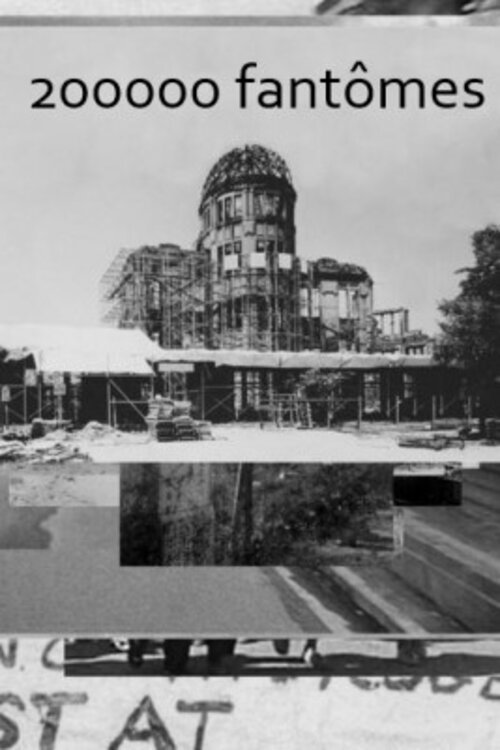
In 1914, the Czech architect Jan Letzel designed in the Japanese city of Hiroshima Center for the World Expo, which has turned into ruins after the atomic bombing in August 1945. “Atomic Dome” – all that remains of the destroyed palace of the exhibition – has become part of the Hiroshima memorial. In 2007, French sculptor, painter and film director Jean-Gabriel Périot assembled this cinematic collage from hundreds of multi-format, color and black and white photographs of different years’ of “Genbaku Dome”.
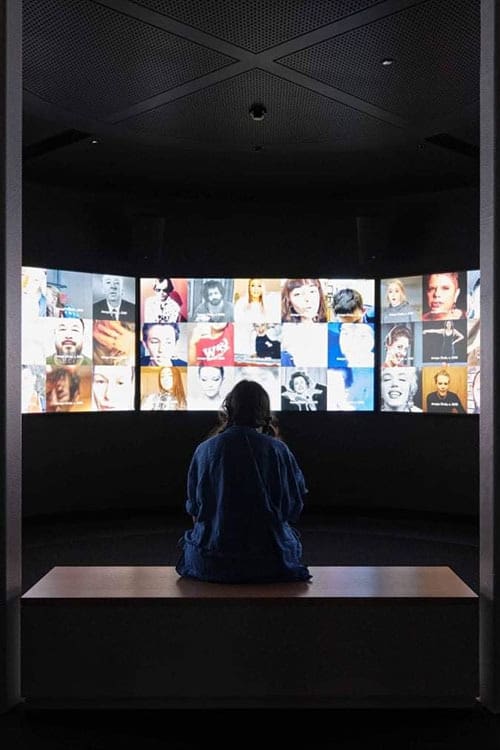
A five-channel video installation commissioned for the permanent exhibition space at the Australian Centre of the Moving Image (ACMI). “The camera doesn’t just capture us, it frames who we are and how we’re seen. Since the camera became more accessible in the mid-20th century, artists and amateurs alike have turned the lens on themselves to create a stage both private and public. This tradition is continued, amplified and transformed through reality TV, the internet and social media, the latest forms to use straight-to-camera techniques to share our common humanity, project authenticity and illuminate how a sense of self can be constructed through the moving image.”
An intimate look into the life of composer Mikis Theodorakis from 1987 until 2017: comprising three decades, four continents, 100 locations and 600 hours of film material. The film interweaves personal moments with archive footage, documentary recordings and fictional pieces, all accompanied by Theodorakis’ music in jazz, classic, electro and rap versions.
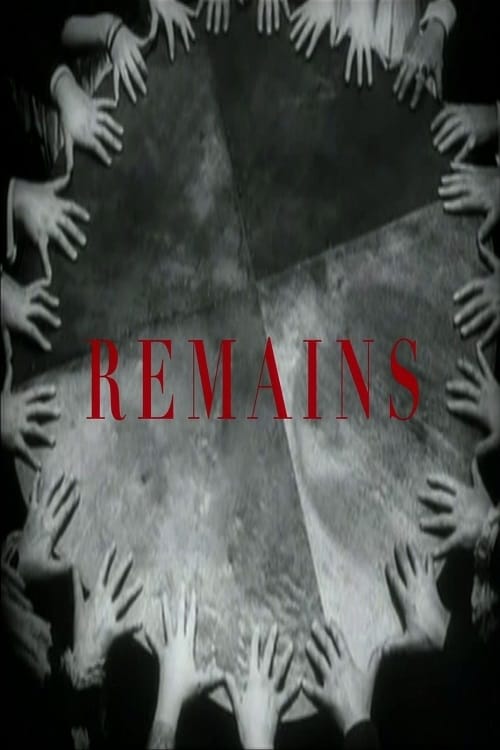
Something takes us underground, where gods and monsters are active, amid the ruins of a world they move around with their innumerable hands. Inspired by Fritz Lang and Richard Wagner, Remains is a daydream.
One of Lawrence Jordan's earliest animated films, PINK SWINE is an energetic and playful mix of various animation styles. Described as "an anti-art dada collage film," this free-form short presents cut-out images animated across old photos (a style picked up by Terry Gilliam a few years later) and found objects that dance to the beat of the rock-and-roll soundtrack. He produced this short during a summer spent with Joseph Cornell and Jordan edited the film entirely in camera, making the upbeat visual rhythm of this delightful lark even more impressive. –Sean Axmaker
No Cast found.
No Trailers found.