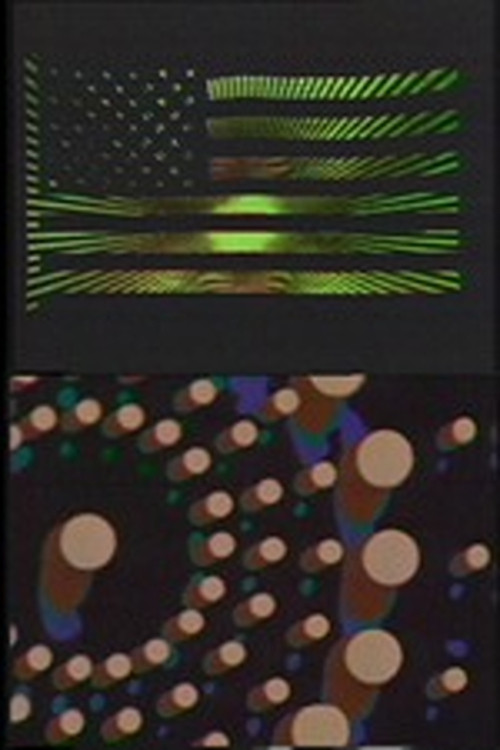
Short video art piece.
No Trailers found.
Writes Ando, "Oh! My Mother was the first work I made using a newly bought 16mm camera I had purchased with the writer Shuji Terayama in Paris. This piece was selected for the Oberhausen International Film Festival. In 1969, there were, of course, no video cameras like ones we see now, and color TVs were only found at broadcast television studios. I had just been employed at the TBS (Tokyo Broadcasting System), and I often snuck into the studios after hours to experiment with the equipment. Oh! My Mother was made using the feedback effect, which is produced by infinitely expanding the image by looping the video."
Produced by WGBH-TV in Boston, the Medium Is the Medium is one of the earliest and most prescient examples of the collaboration between public television and the emerging field of video art in the U.S. WGBH commissioned artists — Allan Kaprow, Nam June Paik, Otto Piene, James Seawright, Thomas Tadlock and Aldo Tambellini — to create original works for broadcast television. Their works explored the parameters of the new medium, from image processing and interactivity to video dance and sculpture.
Using video technology as an extension of his body, Yamamoto interacts with a pre-recorded image of his hand displayed on a monitor.
Video collage distributed by the label Come Organisation. I - IV. Noise, smut, medical procedures, studies on art, interviews and other assorted madness.
Phil Morton's General Motors was created in 1976. Then based in Chicago, the late Phil Morton created this project as a playful and critical video response in conversation with a local General Motors dealership from whom he had purchased a van. Segments 'Colorful Colorado' and 'RYRAL' begin after the video-complaints cease. Produced at the School of the Art Institute of Chicago (where Morton founded the Video Area), this work includes Dan Sandin and Tom DeFanti who collaboratively developed the early Video Art scene in Chicago.
Sylvia Kristel – Paris is a portrait of Sylvia Kristel , best known for her role in the 1970’s erotic cult classic Emmanuelle, as well as a film about the impossibility of memory in relation to biography. Between November 2000 and June 2002 Manon de Boer recorded the stories and memories of Kristel. At each recording session she asked her to speak about a city where Kristel has lived: Paris, Los Angeles, Brussels or Amsterdam; over the two years she spoke on several occasions about the same city. At first glance the collection of stories appears to make up a sort of biography, but over time it shows the impossibility of biography: the impossibility of ‘plotting’ somebody’s life as a coherent narrative.
Writes Imai, "As a photographer during the 1970s, my interest in capturing time led me to explore the video medium. After utilizing video in two or three works, I saw a similarity between videotape and an ancient scroll, in that they both capture a story of our time. I started using physical videotape as a metaphorical representation of time, rolling out the magnetic tape from right to left, representing a narrative from beginning to end."
An experimental short film from Toshio Matsumoto featuring Mona Lisa.
Writes Kobayashi, "In 1972 I started a series of participatory performances where the first person performs an ambiguous action in front of a recording camera; the next person watches the recorded footage and imitates the action in front of a recording camera; the third person repeats the same procedure using the second person's video recording, and so on. Within the repetition of recording and action, the original gesture is transformed by the participants' misunderstanding, interpretation, and memory."
Single channel HD video. Part of the "Distortion III" video album.
Camera, Monitor, Frame is the first installment of Takahiko Iimura's "Video Semiotics Triptych" (the other two works are Observer/Observed, made in 1975, and Observer/Observed/Observer, made in 1976). The work analyzes the fundamental components of video: the camera, the monitor, and the frame, focusing on the role of each within a system of video as analogous to the functions of vision and speech.
Katsuhiro Yamaguchi and Hakudo Kobayashi presented the video performance Eat at Video Hiroba's first exhibition, Video Communication DO IT YOURSELF KIT. Two performers sit at a table. One records the other eating; then they switch roles. The live video feed of the performance was displayed on a monitor in the exhibition space.
Computer Movie No. 2 is a CGI animation created in advance of video-editing software. CTG programmed graphics on an IBM computer, filmed the screen with a 16mm camera, and assembled the frames as an animated film.
In this tape, Ko Nakajima and Video Earth Tokyo interview a homeless man. The subject is initially angry and frustrated, but gradually opens up and shares stories about his life. Under A Bridge was later broadcast on cable television.
Yamaguchi writes, "In April 1969, Image Modulator was shown at the Sony Building exhibition Electromagica '69, using three Trinitron color TV monitors behind a glass that created an optical effect. The glass acted as a literal filter, adding a mosaic effect to the video images."
A member of the collective Video Hiroba, Morihiro Wada also used video in his solo projects. In The Recognition Construction, each subject entering the frame is identified by a narrator, while the video camera slowly rotates. As the rotation speeds up the identification becomes more difficult, and the objects ultimately become "indecipherable."
A video installation using three monitors and mirrors, Ooi and Environs depicts the Tokyo cityscape with electronically modified footage of the city. Aiming to create an interactive environment, images reflected on the mirror shift as audience members move.
A collaborative performance, Image of Seeing--Seeing investigates the meaning of television watching. This work was created for television broadcast on the Nippon Broadcasting Corporation's program "Hyōgo no jikan" (Hyōgo Time).
No Cast found.