A young adult's first-hand account of "accidentally becoming human again" after, and with, trauma induced depression. Lo-fi, vulnerable, and uniquely youthful, "The Afterlife" is a melancholic affirmation of life after death.
No Trailers found.
Self
A day in the city of Berlin, which experienced an industrial boom in the 1920s, and still provides an insight into the living and working conditions at that time. Germany had just recovered a little from the worst consequences of the First World War, the great economic crisis was still a few years away and Hitler was not yet an issue at the time.
During the COVID-19 pandemic, a trans body dreams of the birth of night.
Men still have a privileged position. Yet the concept of a “crisis of masculinity” is increasingly permeating the media, with a loosening of roles and a growing uncertainty about what it means to be a man today. The director Jan Hušek also asks this question. He was still wetting himself by the age of thirteen, which earned him the unflattering nickname that is the film's title. In his open video diary, he captures the physical and spiritual transformation of his journey from boy to man. He returns to the woods and the roots of his childhood trauma. In doing so, he turns the camera on himself as well as on various teachers or his father. Perhaps the mark of adulthood, after all, is not overwrought masculinity, but the acceptance of his inner “pisspants”.
The 360° project tells the story of a peaceful environment featuring a rare case phenomena where a swarm of butterflies is nurturing itself by eating the nectar of flowers showing the beauty but also the fragility of a complex ecosystem. The video installation is configured to work as an interactive 360° experience where the spectator can view the untouched nature by moving / grabbing / touching the nature by his/her hands (mouse) but offers also the possibility to be screened large scale as a flat video loop on a wall, building or in cinema.
Miška is 20 years old, and she has a dream of living in Prague. While coming along her journey, we find out more about her mental health and her love life
To fly a – way from/out of death, don’t hire a taxidermist but take a ride in this taxidrome! Series of 41 Moving Images - this analogy is possible being conservation at its core rescuing what really matters in the world, like nature, habitats, science and art. It is vital. Yet in a continuously changing environment, the flipside of conservation becomes and here it is where the vital feature of conservation becomes its lifelike trait, a fictive life, a fake life. The embalming process consists of 1) imparting a balmy essence to the dead body, as in the ancient world, 2) by filling its blood vessels with formaldehyde to prevent putrification, as in the modern world, although recently with more regard towards more natural treatments, as for instance in bio-art. To embalm also means to “preserve from oblivion”, and “to cause to remain unchanged”, “to prevent the development of something”.
In 1967, Beulah struck Reynosa. Family survives through images from memory circling the wreck. Rituals of celebration and violence like hurricane, shift between dancing, cyanotypes, blue fire and lost family archive. We have come to see the damage that was done and the treasures that prevail. Thus invent colors that burn the eyelid like 火藥.
"This film explores how freedom of speech — including dissent — is afforded to all Americans, and shows freedom of expression in art, music, dance, architecture, and science. The film also emphasizes the importance of the individual’s contribution to the whole of society and demonstrates how a productive and creative society is formed by the open and respectful exchange of ideas. The film was written, produced, and directed by William Greaves" (National Archives).
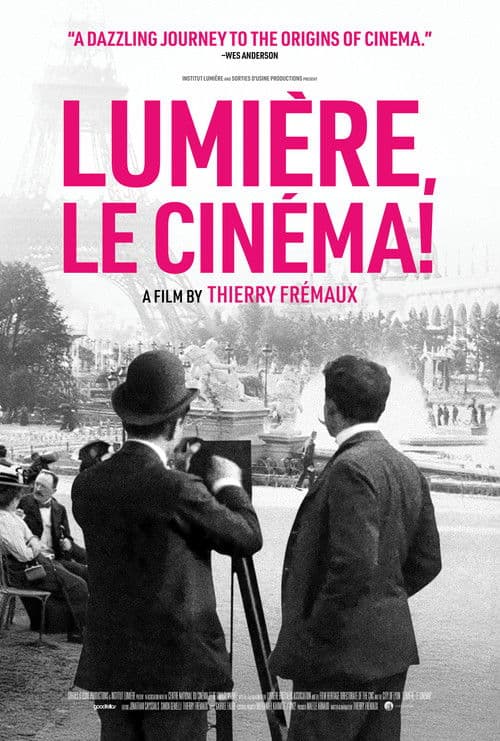
In one of those wonderful coincidences of history, lumière, the French word for “light,” was also the last name of brothers Auguste and Louis, whose brilliant invention, the cinematograph, helped to inaugurate the most beloved art form of the last 130 years. Institute Lumière director Thierry Frémaux uses Lumière, Le Cinema! to guide the viewer through over a hundred shorts—some famous, some forgotten, some never before seen—directed by Lumière and company. In the process, Frémaux illuminates how the brothers employed the camera as a creative instrument as they (and their operators) mastered framing, staging, and subject selection for quotidian and exotic microdocumentaries as well as the first ever fictional motion pictures. The result is not only a glorious re(telling) of the genesis of cinema but a profound meditation on the beautiful world captured—and the mysterious world imagined—by the Lumières.
In a Parisian public hospital, Claire Simon questions what it means to live in women’s bodies, filming their diversity, singularity and their beauty in all stages throughout life. Unique stories of desires, fears and struggles unfold, including the one of the filmmaker herself.
Some spaces draw attention, as if they evoke something that’s about to happen. These are the places where we escape when we dream or die. The only thing that exists is time; we wait for the moment to arrive.
The first film made by Markopoulos after moving to Europe, Bliss was shot over the course of two days using only available light to create a lyrical study of the interior of the Church of St. John on the island of Hydra.
Landscapes revealed themselves through text, paper through movement, while the sun gave them relief. This is a journey across found words, enunciating a discovery, their textures constructing the sea and the waves, in a travelogue from the first exploration, the first step over the sand towards the shore. “Amor” writes this joy to underline it in its time, captured on paper. This film has been composed through a scanner, and it’s the first chapter of the “Reír al Sol” series.
yaya/ayat explores identities, being lost in translation and distance. But at its core it's about the filmmaker longing for a relationship with her geographically distant grandma and her journey to Greece to find her. This is an experimental documentary about how being a part of any diaspora shapes a person's identity.
"Why Me?" is a short documentary film that boldly recounts the extraordinary story of Robert Diamubeni, the sole survivor of flight 9T-TCG in 1990 from Kinshasa to Gbadolite. After coming face-to-face with death, Robert confronts a critical question: “Why me?”. His inspiring journey from despair to becoming a dedicated Christian pastor is a powerful testimony of faith, purpose, and resilience in the face of tragedy.
An intimate portrait of Salt Lake City and its surroundings. Shot on 16mm film.
“Geometric animation made entirely by sculptural methods: cutting, punching, welding colored leader. HETERODYNE is related to some of my other work as RNA to a protein or polypeptide. It was made in abject (if blissful) ignorance of Paul Sharits’ early work.” –Hollis Frampton
The horses in Denys Colomb Daunant’s dream poem are the white beasts of the marshlands of the Camargue in South West France. Daunant was haunted by these creatures. His obsession was first visualized when he wrote the autobiographical script for Albert Lamorisse’s award-winning 1953 film White Mane. In this short the beauty of the horses is captured with a variety of film techniques and by Jacques Lasry’s beautiful electronic score.
Fifteen images of a camera running in a park and in obscurity searching the space of light through distorsion and the sensory of rapid motion.
An up-to-date look at Youth Suicide with an examination of the warning signs, statistics and causes, along with possible ways teachers and parents can use to help their child overcome this important social issue. Also includes a look at the media and its handling of the social issue through the Netflix series "13 Reasons Why" and the Tony Award-winning Broadway musical, "Dear Evan Hansen."