No Cast found.
Switzerland still carries out special flights, where passengers, dressed in diapers and helmets, are chained to their seats for 40 hours at worst. They are accompanied by police officers and immigration officials. The passengers are flown to their native countries, where they haven't set foot in in up to twenty years, and where their lives might be in danger. Children, wives and work are left behind in Switzerland. Near Geneva, in Frambois prison, live 25 illegal immigrants waiting for deportation. They are offered an opportunity to say goodbye to their families and return to their native countries on a regular flight, escorted by plain-clothes police officers. If they refuse this offer, the special flight is arranged fast and unexpectedly. The stories behind the locked cells are truly heartbreaking.
Over 350,000 tons of highly radioactive waste and spent fuel rods are in temporary storage on site at nuclear power complexes and at intermediate storage sites all over the world. More than 10,000 additional tons join them every year. It is the most dangerous waste man has ever produced. Waste that requires storage in a safe final repository for hundreds of thousands of years. Out of reach of humanity and other living creatures. The question is, where? Together with Swiss-British nuclear physicist Charles McCombie, who has been searching for a safe final storage site for highly radioactive nuclear waste for thirty-five years, director Edgar Hagen investigates the limitations and contradictions involved in this project of global significance. Supporters and opponents of nuclear energy struggle for solutions whilst dogmatic worldviews are assailed by doubt
Documentary about thrift shops in Berne, Switzerland and how they want people to recycle and re-use instead of throw away.
Along with several courageous psychiatrists and their clients, the author sets out to film a documentary road movie that takes him to Switzerland, Europe, and the U.S. On their travels in mobile homes, they explore the depths of the human psyche in search of answers to the question: What is the human mind and how does it behave in psychotic extreme situations?
While managers of Swiss banks in the USA ruefully apologize for their tax evasions practices and customer data is disclosed to the American authorities, Rudolf Elmer, former auditor at bank Julius Bär, is indicted for violating the Swiss banking secrecy law on the Cayman Islands. Rudolf Elmer: from insider to critic.
In May of 1982 Julio Cortázar, the Argentinean writer and his companion in life, Carol Dunlop set out in their VW bus on a journey along the highway from Paris to Marseille that, for each of them, was to be their final one. Twenty-five years later, Océane Madelaine and Jocelyn Bonnerave set out to undertake the journey again.
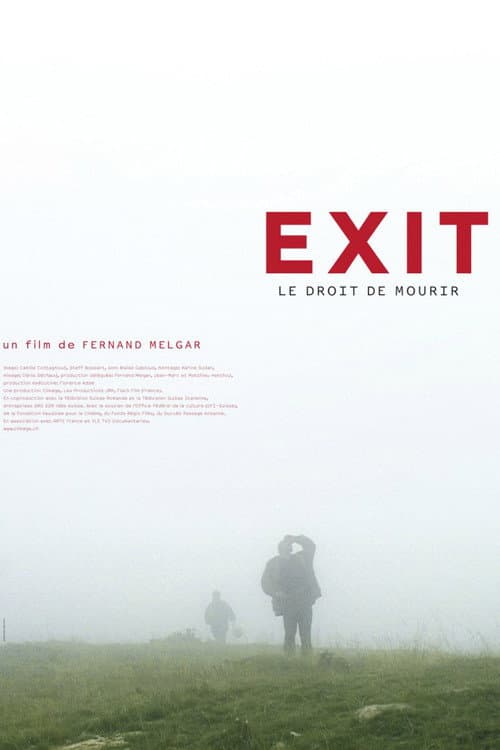
Switzerland is presently the only country in the world where suicide assistance is legal. Exit: The Right to Die profiles that nation's EXIT organization, which for over twenty years has provided volunteers who counsel and accompany the terminally-ill and severely handicapped towards a death of their choice.
No overview available.
Modern Amazons are fierce heroines. They are ready to fight for what is important to them. Without explaining, without compromising, always persisting. They fight for victory in the ring for acceptance, and too, for fellow sufferers and humanity.
An intimate portrayal of the everyday lives of Carthusian monks of the Grande Chartreuse, high in the French Alps (Chartreuse Mountains). The idea for the film was proposed to the monks in 1984, but the Carthusians said they wanted time to think about it. The Carthusians finally contacted Gröning 16 years later to say they were now willing to permit Gröning to shoot the movie, if he was still interested.
The film reconstructs the memories of a divorced family with empathy yet merciless precision. An intimate family story emerges during the investigation into the reasons for the separation. Hinging on the subtle and touching testimonies of the family members, the film delves into complex interrelationships. Actors bring the family's memories alive as if they were their own. The result is a chronicle of a family drama, which the real protagonists complement and comment on – a reflection on the mechanisms and dynamics shaping and directing their family life over the years.
For a month, filmmaker Dieter Gränicher lives in an institution, in the village community of the deaf. As an attentive and increasingly familiar observer, he gets closer and closer to the village's inhabitants, who often suffer from a variety of handicaps, as they go about their daily lives. The film tells the story of the nuances and vivacity of sign language. It portrays human beings who, with great expressive power, overcome the limitations imposed on them by their disability, deeply touching the person opposite.
No Trailers found.